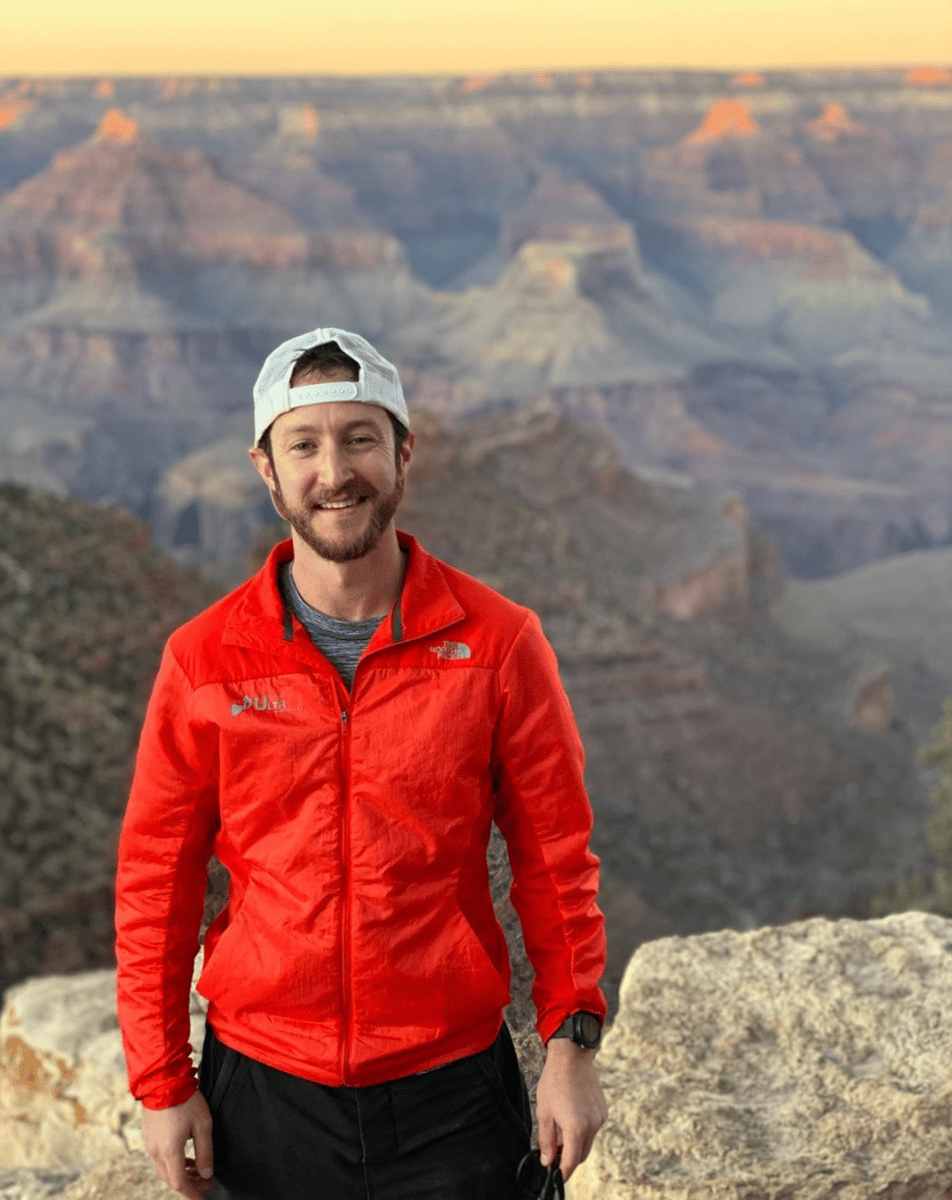
Zach Miller Is Still Here. And He knows Better Than Anyone What That Means.

Zach Miller grew up on the East Coast, studied engineering, wandered onto a cruise ship, and somehow found his way into trail running. He's lived in a cabin off the grid, in a bus, and is currently splitting time between a bus and a house he's building himself. He's hard to fit in a box and he'll tell you that himself.
What he won't tell you, at least not right away, is how close he came to not being here at all.
He's a nine-year North Face athlete who just punched his golden ticket to Western States at Canyons Hundred K. A decade ago he and Hayden Hawks ran away from an entire field at the North Face Fifty in a race people still bring up unprompted. Now they're both lining up at Western States, which should feel like a victory lap except Zach knows better than that. There are no guarantees anymore. There weren't even a guarantee he'd get a golden ticket this year. He went after it specifically because he knew the clock was ticking and he wasn't willing to wait.
🎧 Tune in here:
Listen on Spotify, Apple Podcasts, or other podcast platforms.
The knee that was supposed to end it.
Somewhere in the middle of all this, Zach sat in doctor's offices and heard versions of the same thing. We don't really fix this. You run a lot. It's kind of up to you how much pain you can take.
He didn't accept that. Not out of stubbornness exactly, though there's some of that too. More out of curiosity. What happens if I do the mobility work? What happens if I build the strength and the stability and just keep going? He found PTs who thought there was something to work with and he went after it. And what he thought might be a death sentence to his career turned out not to be.
Every race since has felt like something he knows he almost didn't get. Every finish, every good result, every golden ticket — none of it was guaranteed. That's not a thing he says for effect. You can hear it when he talks about it.
What a decade in the sport teaches you
The fields at Western States are deeper than they've ever been. Zach raced Canyons this year and spent twenty miles in a pack of ten to twenty guys he was legitimately worried about. In 2016 at the North Face Fifty it was basically him and Hayden and then everyone else a long way back.
He pushes back a little on the narrative that the sport has changed beyond recognition. Has it really gotten that much faster or do we just talk about it that way? He's genuinely not sure. What he does know is that the depth is real. The top five at Western States all crack fifteen hours now. The top women are running times that would have won the men's race a decade ago.
And his answer to competing in that environment is the same thing that's always worked. Self-coaching. Curiosity. Being willing to try things that might not work and learn from them either way. He's essentially turned himself into a lab rat over the years — big volume months, low volume experiments, different workout structures — not because he has a formula but because he genuinely wants to know what's possible.
The thing curiosity has taught him most is that you can go too far in either direction. Too much or too little. The answer is usually somewhere in the middle and it takes years to find it.
Run with us. One conversation a week with the people shaping endurance sport, and the part of it you can use on your own run. Join 2,500+ runners.
Flipping the switch
There's a section of this conversation about the mental side of racing that's worth slowing down for. Zach talks about learning to flip a switch mid-race — the moment when everything is hurting on a descent and his brain starts shutting his body down, and he just decides not to let it.
He learned it at a race in Andorra. He thought he had a comfortable lead, got to the last aid station, looked back, and the second place guy was right there. In an instant he went from hobbling to flying down a technical descent. The physical followed the mental so quickly it stopped him cold. He's been thinking about it ever since.
He practices it in training now. When things start to hurt on a descent he deliberately chooses to run with more authority instead of backing off. And more often than not it actually feels better. The pain was mental before it was physical. The brain was trying to protect a body that didn't need protecting yet.
That same switch, he says, works everywhere. Long cross-country road trips. Full days of work. Grocery shopping after a hard training block. The skill transfers because it's not really about running.
The nutrition piece
Zach has been around long enough to stop chasing the number. He spent years figuring out how much he could put in during a run and now his game is different. It's not about doing more. It's about understanding his own body well enough to know what actually works at altitude, in heat, at a given effort level. A nutrition plan needs to be adaptable, not a spreadsheet you try to follow regardless of the conditions.
His wife Jess is a dietitian and they talk about it a lot. He's still not sure he has it dialed in. That's kind of the point. The curiosity never really stops.
What success looks like from here
Zach has won big races. He knows what it feels like and he'll tell you honestly that it's addictive. The attention, the satisfaction, the sense that all those training hours finally paid off — for a week you're on cloud nine and then it fades and you start building toward the next thing.
But he's also thought about what success actually means and his answer is more honest than most. It's not necessarily winning. It's whether you attained something you're satisfied with. You can finish thirty-sixth and call it a success if top fifty was your honest goal. You can also win and feel like you left something out there. Both things are real and pretending otherwise doesn't help anyone.
He's going into Western States grateful to be there, competitive enough to want a great race, and curious enough to want to find out what happens when the heat hits the canyons and he has to flip that switch with seventy miles left to go.
Go Birds.
🎧 Listen to the full episode with Zach Miller on For The Long Run wherever you get your podcasts.
Related interviews
Stay Connected
Subscribe to the For the Long Run newsletter and follow the show on Instagram.
🎧 Tune in here:

Pssssst. Click above to follow along on Substack 👆
About Jon Levitt and For The Long Run
Jon is a runner, cyclist, and podcast host from Boston, MA, who now lives in Boulder, CO. For The Long Run is aimed at exploring the why behind what keeps runners running long, strong, and motivated.
Follow Jon on Instagram, LinkedIn, and Twitter.

1
2