
You spent months training. You spent real money on the entry, the flights, the hotel. Then you land in Berlin or Chamonix or Tokyo feeling like someone replaced your legs with sandbags, and you spend the first two days of your taper trying to feel human again.
Most runners treat that as the unavoidable cost of a destination race. It mostly isn't.
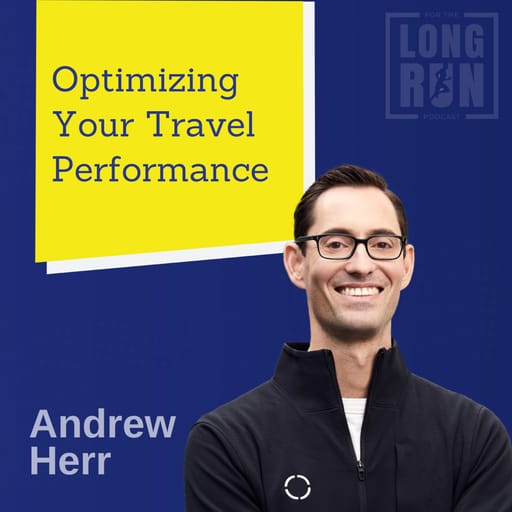
I sat down with Andrew Herr, founder of FlyKitt, to work through what's actually happening to your body on a plane and what you can do about it. Andrew's background is unusual: degrees in immunology, health physics, and national security policy, followed by years running human performance research for the Department of Defense, including work with Navy SEAL units and fighter pilots. He now works with pro sports teams, and his company has supported three NFL franchises through international games.
Here's the short version, then the details.
The short answer
If you're flying to a goal race:
Arrive one to two days earlier than you were planning to.
Cap sleep at about 4.5 hours on most long flights, and closer to three from the West Coast to Asia. The exception is a true overnight to Europe, where you should get as much as you can if you’re arriving in the morning.
On long overnight flights, book the one that leaves later and arrives later.
Fly a Boeing 787 or Airbus A350 if you have the choice.
Eat smaller, higher protein, lower carb meals, and hydrate with electrolytes rather than plain water.
Skip alcohol until you've had one full night of sleep at your destination.
Wear compression socks, bring earplugs, and move around the cabin.
Most of that costs nothing. The reasoning behind it is where it gets interesting.
Run with us. One conversation a week with the people shaping endurance sport, and the part of it you can use on your own run. Join 2,500+ runners.
Why does flying hurt so much? It's not only the time change
The standard jet lag story is entirely about circadian rhythm: your internal clock is set to one time zone and your calendar is set to another, so you feel terrible until they resync.
That's real, but it's incomplete. Andrew's core insight came out of diving research with a Navy SEAL unit, where pressure changes were driving measurable inflammation. He carried the finding over to fighter pilots and then to commercial aviation.
Taking off is the physiological equivalent of climbing an 8,000 foot mountain in fifteen minutes. Once you're at altitude, you're breathing roughly 74 percent of the oxygen you'd get at sea level, for as long as the flight lasts. That combination produces oxidative stress and an inflammatory response.
Then comes the compounding problem. To reset your clock to a new time zone, you need to restrict sleep on the flight. But sleep restriction is itself inflammatory. Andrew's framing is that the immune system treats a double hit exponentially rather than additively, which is why the brain fog, swollen joints, and unhappy gut feel so out of proportion to a single night of short sleep.
That inflammation is also what makes the circadian reset harder. You end up in a loop where feeling bad prevents the sleep timing that would make you feel better.
It reframes a few other travel truisms too. The reason you get sick after flying probably has less to do with sitting near strangers than you'd assume. Cabin air filters cycle frequently, and an airport isn't meaningfully more crowded than a mall. Andrew's read is that inflammation distracts an immune system that would otherwise handle a routine exposure without incident.
How much should you sleep on the plane?
It depends entirely on when you land, and this is where most advice goes wrong by giving one number.
The logic is about protecting the first night at your destination. Sleep eight hours on a flight to Tokyo, wake up around 4pm local time fully rested, and you will not fall asleep that night. Miss that first night and you're chasing the deficit for the rest of the trip. So for most long-haul routes, four and a half hours is the ceiling, and three is often right going from the West Coast to Asia. A rougher first day is a much better trade than a scrambled first night.
The overnight to Europe is the exception. If you're landing at seven or eight in the morning, you have fourteen or fifteen hours to fill before a defensible bedtime, and there's no risk of arriving too rested to sleep. On that flight, take everything you can get. Board ready to sleep rather than planning to watch two movies first.
When should you arrive?
Earlier than you planned. Andrew's first recommendation for anyone racing internationally is to add a day or two on the front end.
That buffer buys three things: room for the circadian shift to happen, time for a proper shakeout run, and the psychological benefit of not arriving into a logistics scramble. For a race you've been building toward for a year, an extra hotel night is cheap insurance.
Does the plane you book actually matter?
More than most people realize, and this is the single most actionable detail in the whole conversation.
Older aluminum aircraft like the 767 and 777 pressurize the cabin to roughly the equivalent of 8,000 feet. Composite-body aircraft, specifically the Boeing 787 and Airbus A350, pressurize to about 6,000 feet, because a carbon fiber fuselage tolerates a higher pressure differential than aluminum. That's a 2,000 foot reduction in the altitude stress driving the whole inflammatory cascade. The 787 also runs higher cabin humidity, around 25 percent against the single digits typical of older airframes.
When Andrew consults with pro teams, one of his first questions is whether they have a choice of charter aircraft. You usually have the same choice on a commercial booking, and almost nobody uses it.
The related booking heuristic for long international overnights: leave later and arrive later. Landing at 7am means grinding out fourteen or fifteen waking hours before you can reasonably sleep. Landing in the afternoon cuts that to twelve or thirteen.
Does any of this change if you live at altitude?
Some of it, yes, and this is worth spelling out because a lot of American distance runners live high.
Cabin hypoxia is about the difference between the cabin and what your body is adapted to, not the absolute number. If you live in Boulder, Denver, or Salt Lake City at around 5,000 feet, an 8,000 foot cabin is a modest excursion rather than a shock, and a 6,000 foot 787 cabin is barely a change at all. You also arrive with the adaptations that make it easier to handle: more hemoglobin, ventilatory acclimatization, and a more willing release of oxygen to your tissues.
The practical consequence is that aircraft type is a smaller lever for you than for a sea-level runner. If you're choosing between a 787 and a 767 out of Denver, take the 787, but don't pay a lot or add a connection for it.
Two caveats. Your altitude adaptation depends on having iron available to build red cells, so if you're running low on ferritin you're getting less of the benefit than you think. And none of it touches the other inputs. Sleep restriction, immobility, cabin dryness, and the time zone shift itself are exactly as disruptive at 5,000 feet as at sea level, and on a long international trip the time zone shift is the variable that dominates everything else.
What should you eat before and during the flight?
Smaller meals, higher protein, lower carbohydrate, with vegetables for the polyphenols and fiber.
Elevated inflammation makes blood sugar regulation less reliable, so a large carb-heavy airport meal lands worse in the air than it would on the ground. Skip the heavy sauces and the ultra-processed options.
Fasting is a legitimate alternative, and the reason it has a reputation for helping with jet lag is that it does reduce the inflammatory load. The tradeoff is that it also deprives your brain of fuel at exactly the moment you're sleep restricted and want to think clearly. For a race trip, eating well beats not eating.
One underused tactic: you can't bring liquids through security, but you can bring solid food in a sealed container. Andrew does this regularly and rarely gets a second look.
How should you hydrate?
Electrolytes, not plain water.
The research hierarchy runs water, then electrolyte solution, then electrolyte solution with carbohydrate. That last tier performs best on paper, but the added carbohydrate can feed the inflammatory problem you're trying to manage, so for most people a straightforward electrolyte drink is the right choice.
Worth knowing: blood volume can drop by around eight percent on a flight. That's conventionally blamed on dehydration alone, but Andrew suspects a portion of it is fluid being pulled into tissue by inflammation, which is the same process behind the swollen feet and ankles.
What about alcohol?
Wait until you've had one full night of sleep at your destination.
Alcohol will help you fall asleep on the plane. It will also degrade sleep quality and add another inflammatory input on top of the two you're already managing. If you're going to drink anyway, the anti-inflammatory tactics in this article matter more, not less.
Andrew's reframe on the airport lounge is the one that stuck with me. The instinct is to extract maximum value from the free bar. But a drink you'd pay three or four dollars for at home isn't worth much against a race you've trained a year for. Get the most out of the trip instead of the lounge.
What gear is actually worth packing?
Compression socks. Sitting still plus inflammation causes blood to pool in your legs. Compression assists venous return and reduces the swelling, so you step off the plane with legs that feel lighter. Put them on the morning you leave or right before boarding.
Earplugs. Easy to dismiss, and the constant cabin noise takes a real toll over a long flight.
A Firefly nerve stimulator. It sits over the nerve that drives the calf pump and triggers a tapping motion in your foot, which can triple blood flow through the leg. It feels strange every time, it works, and you should turn it off before sleeping. One unit runs about 24 hours, so it covers the outbound and return legs.
An inflatable lumbar support. Airline seats are not built around a human spine.
What if you wake up at 2am on your first night?
First, try fifteen or twenty minutes of breathwork or meditation and see if you can get back down.
If you're genuinely awake, stop fighting it and start your day, then plan a nap. The rough arithmetic Andrew uses is that ninety minutes of napping buys you about six additional waking hours. So if you're up six hours early, go until midday, take a ninety minute nap, and stay up from there until a normal bedtime.
Be realistic about what one nap can do. Shifting your clock six hours in a single day requires stacking many interventions, each contributing an hour or two. A nap alone will help without solving it.
Does this apply to domestic races too?
Yes, minus the jet lag. Flying from Denver to Chicago doesn't disrupt your circadian rhythm in any meaningful way, but the pressure change and the low oxygen environment produce the same inflammatory hit. If you've ever flown two hours for a Saturday race and felt inexplicably flat, that's the mechanism.
The good news is that the fix is simpler when you're not also solving for time zones. Move before the flight, hydrate with electrolytes, eat clean, wear compression, and get a light shakeout in when you land.
What's actually in the FlyKitt protocol?
Andrew was refreshingly specific about the components, which is worth documenting even if you never buy the product, because it tells you what categories matter.
Vitamin C, to absorb some of the oxidative stress
Organic pomegranate extract, for plant polyphenols that activate cellular protection pathways
High-dose 1:1 EPA/DHA omega-3, to keep inflammation low and support the brain
Methylated B6 and B12, for energy and to suppress melatonin when you don't want it
A sugar and methylated B vitamin mix on arrival, to reset the peripheral circadian rhythm in the gut and liver. Sugar is normally the wrong tool for inflammation, but here it's serving a specific timing function
Magnesium glycinate with low-dose melatonin, at one milligram, two at most. The melatonin is a timing signal rather than a sedative, which is why the high-dose bottles at the pharmacy tend to backfire
Blue light blocking glasses
The company's internal data puts 93 percent of users at minimal to no jet lag traveling anywhere in the world. In a study with Inter Miami during an around-the-world trip, players using the protocol reported 94 percent fewer travel symptoms than those who didn't.
There's a domestic version at under a third of the price of the international kit, which is the more relevant product for most American racers.
The pre-race travel checklist
Booking
Add one to two days on the front end
Choose a 787 or A350 where possible
On long overnights, pick the later departure with the later arrival
Day of travel
Light workout before heading to the airport, nothing hard
Pack solid food in a sealed container
Compression socks on before boarding
Electrolytes, not just water
In the air
Cap sleep at roughly four and a half hours on most long-haul, three to Asia
On a true overnight to Europe landing in the morning, sleep as much as you can
Smaller meals, higher protein, lower carb
No alcohol
Earplugs in, and get up and move
On landing
Easy shakeout run or walk to flush the system
Sauna or cold plunge if the hotel has one
Hold the line on that first night's bedtime
Save the first drink for after a full night of sleep
Listen to the full conversation
Andrew Herr goes much deeper on the immunology, the military research that led here, and what he's learned working with NFL teams and an athlete attempting seven Ironmans on seven continents. And check out FlyKitt!
New to For The Long Run? Start here.
For The Long Run explores the why underneath the miles. I've been talking to runners, founders, coaches, and scientists since 2019 about what keeps people running long, strong, and motivated, and it's the flagship show the Long Run Labs Network grew out of.
FOR THE LONG RUN: EXPLORING THE WHY BEHIND RUNNING
The Science Behind Travel Performance and Health Optimization with FlyKitt Founder, Andrew Herr
This article covers general performance and travel strategy and isn't medical advice. Talk to your doctor before starting any supplement protocol, particularly if you're managing a health condition or subject to sport drug testing.