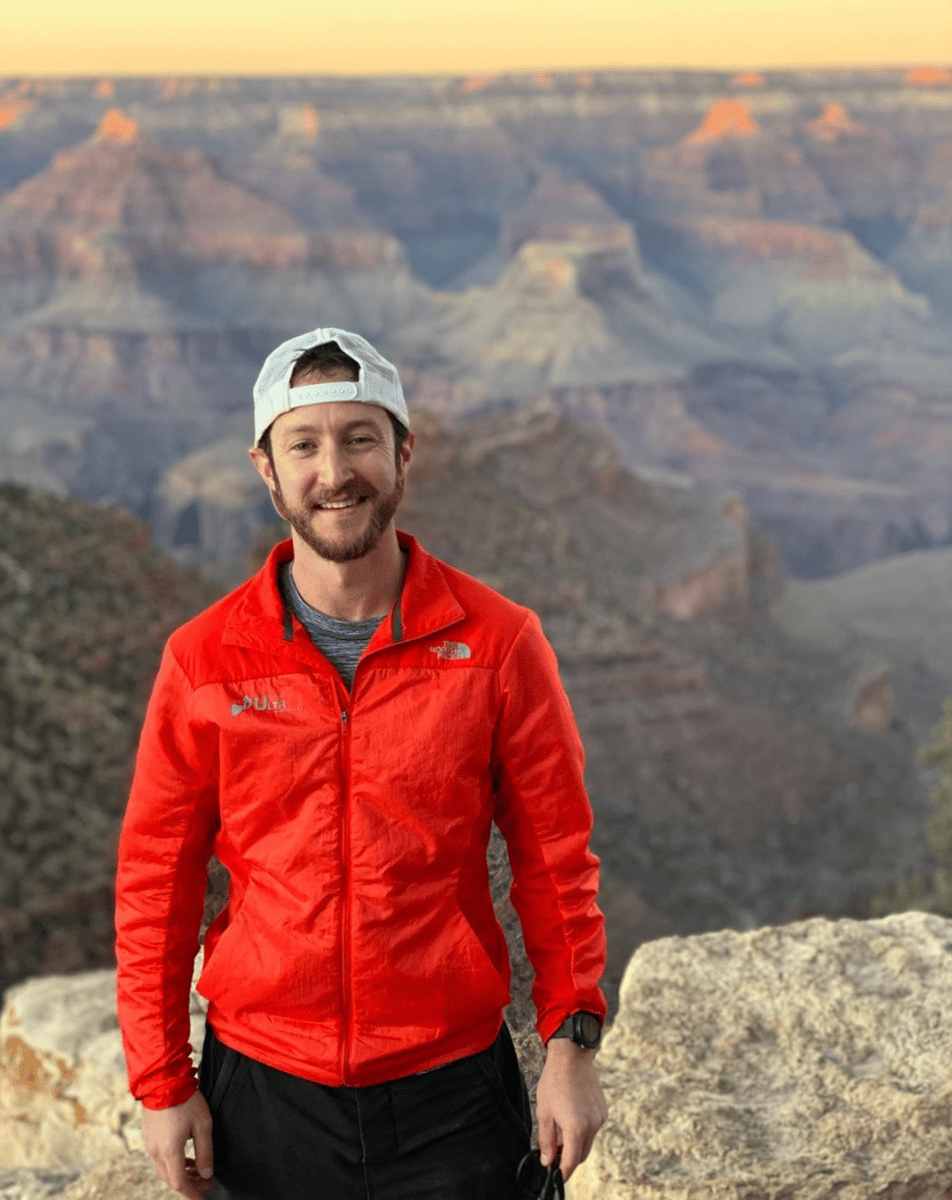

There's a version of Kyle Siegel's story that starts with SpaceX and ends with a ski pack. But the more honest version starts with a $550 backpack on Rainier that was so light it was practically useless: you couldn't get into it with skis mounted on the back. That peak frustration moment was the actual founding of Raide, a ski and running gear brand built on the premise that the best equipment is the kind you forget you're wearing.
🎧 Tune in here:
Listen on Spotify, Apple Podcasts, or other podcast platforms.
The Three Types of Companies (And Why Most Get It Wrong)
Kyle came to the outdoor industry through engineering. He worked at SpaceX doing vibration analysis, ski bummed in between jobs, landed at The North Face in performance outerwear product management, and eventually left to start a tech company before founding Raide in 2023. The throughline in all of it was a builder's obsession with solving problems correctly.
His framework for understanding companies: product-led, sales-led, and marketing-led. Most brands claim to be product-led. Kyle's view is that a lot of marketing-led companies are very good at making you think they're product-led. The distinction matters because it determines every downstream decision, from pricing to athlete partnerships to how you think about growth.
Raide launched with a ski touring backpack, two press placements (Blister and Powder Magazine), and an athlete team. First day revenue was $20K. Kyle had no idea that was exceptional. He'd never built a consumer brand before and had no commercial benchmarks to compare it against. That context-free starting point was, in retrospect, an advantage: he wasn't optimizing for a number, he was solving a problem he had personally.
Why He Won't Discount
Raide goes on sale once a year, on Black Friday. That's it. No affiliate discount codes, no influencer promo rates, no end-of-season clearance.
The reasoning is straightforward: discount-driven pricing is a lie told in two directions. Brands inflate their prices because they know a percentage of customers will pay full price, and they use promotions to drive volume from everyone else. Customers learn to wait. The relationship between brand and buyer becomes transactional and conditional.
Kyle frames Raide's pricing model around a different promise: the price is as low as it can be for the product quality they're building. If you buy it today or six months from now, you pay the same amount. He cites Costco as the clearest version of this logic: Costco's prices are low because they're committed to honest margin, not because they're running a perpetual sale.
The practical consequence is that Raide's customer acquisition cost is very low, but not for the reason that surfaces on a dashboard. Their CAC looks artificially low because they've built a brand that makes paid advertising convert better when it does appear. The real driver is word of mouth: the number one source people cite in Raide's post-purchase survey is a recommendation from another customer.
Athletes as Conversion, Community, and Content
Raide runs an athlete program, not an ambassador program or an influencer program. Kyle is intentional about the language. An athlete program is what it sounds like: you work with people who actually compete and push the sport at the highest level.
His framework for evaluating any partnership breaks into three buckets: conversion, community, and content. Most athletes provide value in one or two of those three. A conversion-focused partner might have modest reach but high credibility when they recommend gear. Their audience trusts their opinion on equipment. A community-focused partner might not have massive Instagram numbers but is deeply embedded in a specific scene, like a guide in the Roaring Fork Valley who everyone in that community knows. A content-focused partner creates material that's genuinely useful for brand education, whether or not they have a big following.
The clearest example of how this plays out is Ana Gibson, Raide's first running athlete. A mutual connection mentioned Kyle was building a no-bounce running belt before it existed. Ana reached out, Kyle told her to trust him, she agreed on a paid engagement, and the partnership grew from there. She now uses Raide across both skiing and running, qualified for the Olympics in ski mountaineering, and at one point had a Raide pack hand-delivered to altitude in Italy by a customer support team member who had never been to Europe. That line item lives somewhere in marketing or travel. Kyle doesn't seem to regret it.
Brand Marketing as a Trust Contract
Kyle's philosophy on brand marketing comes back to a Steve Jobs framing he paraphrases roughly as: brand is a trust contract between a company and a consumer to deliver a certain experience. For Raide, that experience is freedom and flow. The products disappear when you're using them. They don't slow you down or create problems on top of the ones you already have in the mountains.
Everything in the brand works backward from that promise: athlete selection, visual content, product development, pricing. Kyle describes wanting Raide to feel like it's from the future. The aesthetics, the materials choices, the way products are shot. All of it is meant to reinforce a single feeling.
The contrast he draws is with performance marketing. He spends under $10K a month on paid advertising and is skeptical of the entire digital attribution industry, where every channel claims credit for the same sale. His read is that most of what looks like performance marketing success is brand equity doing the actual work, with paid advertising collecting the conversion credit.
Fundraising: The Mistake That Still Stings
Kyle has taken very little outside capital relative to brands at a comparable stage. Two small institutional investors and mostly angels. His framework for fundraising comes down to three questions: what outcome do you want, what do you think is achievable, and how much risk are you willing to take?
The biggest mistake he made was undervaluing Raide early on. He took money at too low a valuation because he didn't believe the company would become what it has. He was trying to protect investors from a bad deal. In hindsight, that conservatism came from not believing in himself and the brand enough. The manifestation was spending too much time protecting the downside instead of asking what happens if everything goes right.
His advice for founders navigating the same tension: if you're not the one who believes your business is going to be big, don't start it. He now tries to make decisions assuming things will go right, as long as no single decision could sink the company.
On strategic investors, his view is that every person on the cap table should be someone he can call for advice on something specific. The dollar amount matters less than what the investor can open up, whether that's distribution relationships, marketing expertise, or operational experience.
What He Wishes He'd Known
Kyle came out of six years in San Francisco tech with a particular posture: I can disrupt this, I'll ignore how incumbents do things. That posture cost him. There are reasons why outdoor industry companies do things the way they do, and dismissing that institutional knowledge as outdated slows you down.
The more specific lesson is about hiring. He describes two modes: offensive hiring, where you bring people on to create capacity before you need it, and defensive hiring, where you hire when something is already on fire. Most of his early mistakes trace back to waiting too long. He's now trying to build the team ahead of the need rather than in response to it.
Raide is currently building toward eight employees, using recent investment to fund that hiring plan and shore up inventory. They've been out of stock more than in stock for most of the past two years, a function of early growth outpacing supply chain, not a lack of demand.
Top Takeaways
Build the product you wish existed: Raide launched with no commercial pressure because Kyle was solving his own problem. That absence of external expectation kept the product honest. When there's no number you have to hit, quality becomes the only target worth optimizing for.
Discount pricing is a trap in both directions: Brands that build in discount cycles train customers to wait. If your pricing strategy depends on a sale to move volume, you've already compromised the brand relationship. Price as low as you can for the actual product, then hold the line.
Evaluate partners across three dimensions: Conversion, community, and content. Most athletes and creators provide value in one or two of these. Know which ones you're hiring for and don't expect a community-builder to also convert at scale.
Brand marketing works; you just can't track it cleanly: Low CAC numbers that look like performance marketing wins are often brand equity doing the heavy lifting. Word of mouth is the hardest thing to manufacture and the most durable customer acquisition channel that exists.
Value your company like you believe in it: Taking early investment at a low valuation because you don't want to give investors a bad deal is a form of self-doubt that compounds. The more dangerous scenario isn't overvaluing; it's underestimating what you're building.
Hire offensively, not defensively: Waiting until something is already on fire before bringing in help is the most expensive way to grow a team. Building ahead of the need creates capacity instead of just responding to crisis.
Stay Connected
Follow Kyle on Instagram and find Raide at raideresearch.com or on Instagram at @raideresearch.
Subscribe to the Long Run Labs newsletter and follow the show on Spotify, Apple Podcasts, or other platforms.
🎧 Tune in here:

Pssssst. Click above to follow along on Substack 👆
About Jon Levitt and For The Long Run
Jon is a runner, cyclist, and podcast host from Boston, MA, who now lives in Boulder, CO. For The Long Run is aimed at exploring the why behind what keeps runners running long, strong, and motivated.
Follow Jon on Instagram, LinkedIn, and Twitter.
