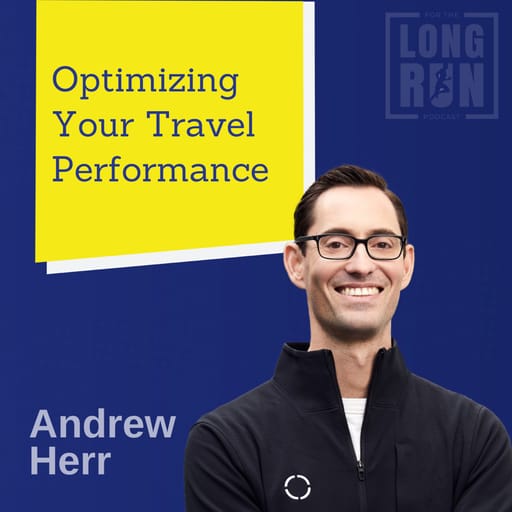
Transcript 0:00 [upbeat music] Instead of saying, "I have to get the most out of the lounge," which means drinking and eating all this kind of junky food, how about making the most of getting out on your trip? 0:12 And so I think that mindset of, you know, if your trip's focused on the race, then getting the most out of the race, you're getting the most out of your body. 0:17 But yeah, really focused on getting the most out of your trip, I think is great because then it's like, "Why would I drink this stuff here?" Like, you know, I could have that drink for three or four dollars at home. 0:27 Like, keep your body clean, feel great, have a race you can be proud of, and move around. Welcome to For The Long Run. 0:37 We explore the why behind what keeps runners running long, strong, and motivated, and how they've been able to achieve sustainable excellence. I'm your host, Jonathan Levitt, and we're so glad you're here. 0:50 This episode is brought to you by Amazfit, the GPS watch that's seriously challenging the big brands. I've been using their T-Rex 3, built for adventure. 0:58 Whether it's ultrarunning, big mountain days, or just not charging it for a week or two, it's got all the features and accuracy you'd expect from top GPS watches, but at a fraction of the price. 1:08 Amazfit's also giving back to the running community, partnering with athletes like Grant Fisher, Ruth Croft, Rod Ferber, and supporting the Long Run Labs collective of running podcasts. 1:18 If you want a watch that performs like the big names, but doesn't break the bank, check out amazfit.com or hit the link in the show notes. 1:25 You'll find the T-Rex 3, the New Balance 2, and the Helio strap for top-tier heart rate and recovery tracking. 1:32 I used it alongside a high-quality machine during my VO2 max test with Eternal, and it was spot on from a tracking standpoint. Use code FTLR for 10% off your purchase. 1:41 Thanks to Amazfit for supporting the running community and the content we create. If you've been curious about leveling up your health and performance with Eternal, this is the week to jump in. 1:53 Eternal is the proactive healthcare team built for athletes by clinicians who are athletes themselves, too. And for Black Friday, they're giving you 25% off every plan. 2:02 That includes the PCP or primary care membership at $499, the health span bundle at $1299, which includes a performance assessment and a consult to review the data, and even the concierge membership tier, normally 6K a year, at $1500 off with this promotion live through December 1st. 2:20 All plans also include a 70 biomarker blood test, a DEXA scan, and other perks. I've been working closely with the team, and it's honestly one of the most thoughtful, high-touch approaches to health I've ever seen. 2:31 If you've been waiting for a sign to start taking this part of your life seriously, this is it. 2:35 Eternal works best for those who live in New York or San Francisco, but there are options for many others nationwide, especially if you can get to one of those cities once a year. 2:43 Head to eternal.co and use the Black Friday offer while it's live. Again, that's 25% off all plans, and the discount applies automatically. 2:51 Your future self is gonna be very happy you did this, and feel free to reach out to me directly with any questions. And welcome back. We have Andrew Hurd joining on the podcast today. 3:04 Andrew, thanks so much for taking some time to chat. It's great to be here, Jonathan. Of course. So the first question is always a tough one, and that question is, who is Andrew? 3:11 There's a lot of different answers to that question, obviously. I think in the context of this call, I'm the guy trying to help people feel better and making it easier to be healthy while you travel. 3:21 And that comes from a long history of working with the military and pro sports teams and inventing some tech, and here we are today. 3:29 So we've known each other for a number of years from my work at InsideTracker and your work at Flykit and some of the other businesses you've been a part of and organizations you've been a part of. 3:40 And so it's fun to be able to connect here and dive further into how travel impacts performance and how you actually do have a lot more influence on the levers that can be pulled on so that, you know, when you land in Berlin or Sydney or Tokyo or Boston or wherever, you're not at the mercy of, you know, if you feel good. 4:01 You have a little bit more control or a lot more control over that, "Yeah, I feel good. I'm ready to perform." 4:06 Yeah, and actually, like, the prior businesses are kind of relevant to the story, so we got to know each other a little bit when we were running a very high-end health and performance coaching service. 4:15 We were running blood tests on everyone, wearable data, self-report, all these things to run N of 1 experiments and figure out, "Okay, does this supplement work for you? Does that supplement work for you? 4:24 What about this diet change, this exercise change?" And one of the things we saw through working with these very successful, busy people was that travel was one of the biggest challenges for their health. 4:35 And that, alongside having invented a-- This statement's always a little bit awkward to say, but, like, having invented a cure for jet lag for more than 90% of people, it's only awkward because it seems crazy, but it's true. 4:48 We have the data for it. 4:49 Between those two things, we decided to focus on travel because it's such a big impact, and we now have a suite of tools and products around travel, but the core of it is based on some really fascinating insights around how flying causes inflammation in the body. 5:05 You mentioned something that I wanna dive into, and I've been, like, itching to write a Substack article or LinkedIn post about it. 5:10 We've both been involved in blood testing and blood analysis for a long time, and in the last week or two, we've seen WHOOP and Oura both release a blood product. 5:20 You've spent a lot of time in the, like, hands-on, working with people one-on-one standpoint. 5:25 What's your take on, you know, everybody having a blood testing option now, and how did you interact with a program like that in the past? I think there's a couple parts of this. 5:37 One is the, like, enough testing that people can catch things early. I'm a super big fan of that. 5:42 Just got off a call with somebody not that long ago, was like, "Yeah, your blood sugar is now above normal and your insulin is skyrocketing. Like, you're on the train to type 2 diabetes direct. 5:56 And-- But if you make changes now..." And got an email, like, a few days later being like, "I've already instituted these changes," and it's beautiful. I love that. So catching things early I think is great. 6:06 Now, you have to be smart, though. 6:07 Like- You know, the average person who's got a blood sugar that's, like, a little bit elevated but doesn't test their insulin, which might be low, doesn't realize that that high blood sugar in the morning is stress and not diabetes and not metabolic problems, or doesn't see their A1C and know that it's, you know, not high all the time. 6:24 So, you know, there's some real nuance here, and that's the challenge is, like, with the laws the way they are about giving people advice and the risk aversion being what they will be from bigger companies, like, can they figure out how to give really good advice? 6:38 And then also just, like, can you deliver nuance at scale? So that's the kind of first one or two pieces. And then the next piece is like, okay, you've gotten one blood test, so what now? 6:48 The answer is the only really great way to use that data is to inform changes, but then you gotta see if those changes are working. 6:56 And so you really have to run things in experiment, and so you need to be running pretty intentional about making one or a small number of changes at a time and then retesting at a reasonable interval. 7:06 You know, and reasonable interval depends on what you're testing, obviously, but... 7:09 So that's kinda how I think about it, and we also think a lot about the nuance of, like, "Hey, your ALT," which is a liver enzyme that can tell us if you likely have fatty liver disease, "is in the normal range, but just a little bit under the top. 7:23 Let me tell you, twenty years ago, the normal range was lower, and so you probably are on that train already, but, like, it says it's normal." 7:30 And so there's always more nuance to be had, but the general case is, like, can we deliver people the insights from it, and can we help them run experiments to know if it's working? 7:39 I love what you said, "Can we deliver nuance at scale," right? That's what, like, everyone is chasing and trying to understand. 7:46 Okay, it-it's one thing to help, you know, ten people or a hundred people or even a thousand people, but how do you help lots of people? 7:52 And I feel like that's kind of the golden goose of what all these companies are chasing, which is let's build a strong business, but also let's help a lot of people go beyond just, you know, eat more oatmeal and take a vitamin D supplement and really, you know, understand how to influence health foundationally. 8:09 And I think there's... You know, it's interesting. These moves are also a response to function health, bringing blood testing wide and being really successful. 8:17 And so there's an interesting dance going on of, like, is it the wearable plus the simple blood tests, or is it the in-depth blood test that Function offers? And I think there are pros and cons to each strategy. 8:29 I'm very interested in, you know... I think about the dataset we have to build algorithms to make recommendations that they don't really have because we've been where the rubber meets the road more than they have. 8:38 And so I think about how do we leverage the learnings from N of one experimentation in a world where more people have data. Totally, and that was my experience at InsideTracker too, with a hundred thousand users, right? 8:49 Nobody has longitudinal data on a hundred thousand users over a five-plus-year period, and seeing that trending, which is interesting. 8:58 And now I'm consulting for a company called Eternal, and they've gone in totally the other direction, and the goal is to have doctors doing the interpretation and have humans doing the interpretation and performance dieticians who, you know, spent time in military and special forces. 9:15 And so it's just, like, a totally different approach to let's let algorithms drive guidance and compile as much data as possible versus let's let career doctors and dieticians who are also endurance athletes, you know, apply the interventions and then ask, "Did it work?" 9:33 And have that ongoing feedback. I wanna set the stage a little bit more. 9:37 Can you share a bit more about your background with the US military and, you know, what gives you the credibility to speak from a position of, like, "I really get this"? Yeah. 9:46 I always say if I lived my life ten times, I would've been a doctor five of them. My dad's a doctor. I grew up around it. My mom's side of the family is, like, military, military, military, military. 9:55 Some no shit war hero stuff. Anyways, I ended up with this really weird background. 9:59 I ended up with a degree in immunology, a, a master's in immunology, a master's in health physics, and a third master's in national security policy, and somebody walked into the career center at Georgetown, where I was going to school, and said, "We need someone who does biology, national security, and can write." 10:11 And they're like, "Well, we know this guy, Andrew." 10:13 And serendipity and synchronicity being what they are, I ended up taking a job running, mm, studies looking at the future of human enhancement for the Secretary of Defense's private think tank on the future of warfare. 10:24 So sort of like what could be twenty years from now, what could be... What might we be able to do? What might our adversaries do? 10:31 And so that really, I think, set the stage to think about the future and think about what we should be doing. 10:36 And then I spent a few years working on how do we use data coming in from venture capital investments, from scientific publications, from patents to predict where technology's gonna go and then decide where the military should invest. 10:50 And along the way, I also got to work with individuals in, like, more rubber-meets-the-road stuff. 10:55 You know, work with some people, getting them ready for deployment, including some special ops guys, and then was working on a project kind of that I initiated with a Navy SEAL unit trying to figure out some very long-duration missions and how to optimize endurance and performance. 11:10 And that exposed me to data showing that the pressure changes in diving were causing inflammation. 11:17 And then I was able to tie that based on some work I did with them and then with fighter pilots to show that the pressure changes in flight were causing inflammation, and that was sort of the start of figuring out that every time we fly, our system gets totally dysregulated by the pressure change in flight and then the low oxygen environment. 11:37 Taking off in a plane is like climbing an eight-thousand-foot mountain in fifteen minutes. 11:41 [chuckles] That's gonna do a number on your body, and then you're at, like, roughly seventy-four percent of normal oxygen for however long you're on that plane. 11:49 And so these things cause oxidative stress, can cause inflammation, and it's not that the circadian rhythm thing isn't key to jet lag, it is, but the inflammation is what causes it to be so bad and then also makes it harder to reset your circadian rhythm. 12:04 Fast-forward to me being a private coach with high-end executives. And by the way, this is no longer just what I do with the military. This is sort of my whole story arc, but here we are. 12:13 Somebody said, "Hey, Andrew, we're flying to Asia from the US. We land at four PM. There's a big business dinner that night, and they wanna negotiate starting the next morning at, like, seven AM. 12:21 They're using jet lag as a negotiating tool. What should I do?" And I was like, "Great. When's your next trip?" He's like, "Tuesday." Of course, it was Sunday, and I was like Thanks, David. 12:28 I'll get you something tomorrow. And so I took all the knowledge I had, put it together, circadian rhythm, sleep, managing the effects of not enough sleep, s- the inflammation from that. 12:38 It's important, like managing inflammation, all these things together, circadian rhythm, resetting the central circadian rhythm of the brain, resetting the peripheral circadian rhythm in the body and liver. 12:48 Put it all together, typed it on a Microsoft Word document, gave him a box of supplements and stuff. He left, sends me an email like one or two days later from Korea. "What did you do? 12:58 I just slept eight hours my first night." And if that first one hadn't worked, I probably would've just never thought about it again. But instead, it worked, and it kept working, and it kept working. 13:07 And there was clear that there was a protocol to eliminate jet lag for most people. How did the negotiation go? Great. He nailed it because, you know, nobody expects you to be totally fresh. 13:18 Now, his partners were just a mess, apparently. [laughs] But nobody expects you to be totally fresh, and you come in totally fresh, and suddenly they go from thinking they have the advantage to you have the advantage. 13:28 It's such a fascinating tactic to force someone to fly in and then get them going at seven AM the next morning. Okay, so what did that unlock for you? What, what was the like, there's something here? 13:38 Yeah, I mean, so basically I was like, wow, like this protocol works or it seems to work. Like, you know, it's pretty hard to placebo somebody out of jet lag. 13:45 I mean, I'm a convincing guy, I like to think, and people like me and such, but that's a pretty hard placebo. So basically the next step was like, hey, let's try it again with other people. 13:54 Tried it, refined it, refined it, tried it, tried it, refined it. And because it kept working, I was like, okay, there's something real here. 14:00 And this hypothesis that the pressure changes in flight causing inflammation, I can also just see it in my body. I'm-- you know, I've spent a lot of time experimenting my body. Um, some parts of me are... 14:10 like everyone, some parts of me are more susceptible to inflammation than others. And I was able to really track in my own body and then run these protocols and variants of the one myself. 14:17 And so one, guinea pigged it myself. I used to feel terrible flying. In fact, it really, like for a while, I wanted to stop traveling entirely. But now I have a protocol. It's sort of the next generation Flykit protocol. 14:30 We have the current one, and I'm always testing the next gen one on myself and like, man, it's hard to believe how big a difference it makes. So what did you do next? 14:38 So that was a point in my career where I was starting to think about scaling. You sort of said earlier, like, how do we go from helping ten or twenty people to helping ten thousand or a million or ten million? 14:48 And so I started then really thinking over time about how to scale this. And my initial thought was like, I have this special thing, this jet lag protocol. Let's start with that. It's customizable via algorithm. 15:00 So, you know, the best things are customized and the best products are customizable automatically, right? Like you just can't have a person, me, doing these for everybody. 15:10 So it was kind of the perfect storm, and my belief was that we could develop these customizable via algorithm products for sort of jet lag, then maybe go to sleep and, you know, increasing complexity. 15:20 And so I spent a lot of time building the concept and then eventually failing to raise venture capital money and then learning how to do it, and then raising venture capital money to build a company to build this jet lag product first. 15:31 And we closed our first funding round the Friday before everything closed for COVID when travel, international travel- Classic... was just not a thing. And so of course, like in that moment, what do we do? 15:43 We pivoted to the long-term vision, which was like, "Hey, can we just collect these unique N of one data sets and start building kind of a holistic program?" 15:52 And so we used the venture capital money to start that, built that, got that bigger, raised more money. Was that Fount? That was Fount. 15:59 And then saw that that model we were building at the very high end wasn't gonna be scalable enough to get where we wanted to go for that. And in the meantime, the jet lag product suddenly five X'd in six months. 16:14 And so at the same time as like we were like contemplating how to scale, the jet lag product was hockey sticking. And from the coaching, we saw what a big deal travel was. 16:26 And so we used those two signals to say like, let's go all in on making it easy to be healthy while you travel. And so now we have Flykit, our jet lag product. 16:36 We ran a study with Inter Miami, the pro soccer team where Messi plays. They used it on around the world trip. Ninety-four percent less travel symptoms for people who use Flykit compared to those who didn't. 16:45 In our internal data, ninety-three percent of people can travel anywhere in the world with minimal to no jet lag. 16:51 And we just launched our Flykit domestic product because you don't get jet lag flying to Chicago usually from anywhere in the US, but man, do you still get that inflammatory hit from flying. 17:02 So now we have a simpler, cheaper protocol for domestic travel, and then we have AI that can help you find the healthiest food anywhere in the world. We have AI that can help you work out in any gym in the world. 17:10 Just take photos of the equipment, it makes a workout for that gym. And so kind of like really focused all around healthy travel and making that easy for people and smooth. 17:20 Can you talk more about the difference between the inflammation component and the time zone challenges? Why do people think that the time zone is the biggest issue? 17:28 It is a huge issue because you do wake up and fall asleep at the wrong times when you're in another place because you haven't reset your circadian rhythm. 17:35 But the problem is to reset your circadian rhythm to the right time zone, you can't sleep too much. That seems like a strange thing, right? 17:42 But if I get on a plane to Tokyo and I sleep eight hours, I'm gonna wake up at like four PM Tokyo time. And then if I get off that plane, I'm not gonna be able to go to bed at like six hours later if I slept eight hours. 17:52 So now you have to sleep less, but the problem with sleeping less is sleeping less causes inflammation in the body. Short sleep, sleep restriction causes inflammation is sort of the first order negative effect. 18:01 And now you have inflammation from this and inflammation from flying. And in the immune system, a double hit is exponential. And so now suddenly you feel bad. 18:09 You've got the brain fog, your body feels terrible, joints swelling, gut's off. That stuff dysregulates all kinds of rhythms in the body. 18:17 So now you've got all these inflammatory things that are gonna mess with your sleep, and you're just not gonna be able to go to sleep at the right time. You haven't reset your circadian rhythm. 18:24 So what we're doing is we're not ignoring the circadian thing. In fact, we're really doubling down on it. 18:28 But by blocking the inflammation, not just from the flying, but also managing it from that initial short sleep, we can give you exactly the right amount of sleep at exactly the right time. 18:37 And then use supplements, light, meal timing, you know, the amount of sleep we give you, all those things to shift your circadian rhythm. 18:43 And when we do that together in a concert, that's how we flip your circadian rhythm overnight, get rid of the inflammation. And we hear from people like, "Wow, I..." 18:51 Some people tell us they feel better than they do at home on their first day. [chuckles] But, like, people just tell us they feel great. 18:56 And we get this comment very often, which is, "I was kind of skeptical when you said you could cure jet lag, but I figured, 'Hey, you got a money-back guarantee. 19:02 I'll take a flyer on it,' but now I'll never travel without it." And so that obviously is super gratifying to us. So you guys sent me a kit. 19:09 I have not had a chance to use it because I have not flown anywhere with more than a two-hour time zone change, so I've been, like, waiting to use it and hoping to go somewhere a bit further in the next few months with, like, a six, seven-hour flight. 19:23 So it'll get a chance to be used soon. But can you talk about, like, the nutritional components of, like, what enables this? Yeah. So the first thing you wanna do is block as much of that inflammatory signal as you can. 19:35 So that means, you know, soaking up some of the oxidative stress. In particular, vitamin C is helpful for that. 19:41 And then we wanna activate the cellular protection systems in the cells, and so we use plant polyphenols for that. We use an organic pomegranate extract. 19:49 And then you gotta keep the inflammation level low and support the brain, and so we're using a high-dose one-to-one EPA DHA, specially refined omega-3 fatty acid composition to do that. 20:01 And then you need to boost someone's energy and lower melatonin levels when you don't want them high, and then you need-- So we use a methylated B6, B12 mix for that. 20:12 Then when somebody arrives, you need to reset not just their central per- circadian rhythm, but their peripheral, so the gut, liver. And so we actually use a sugar methylated B vitamin mix for that. 20:22 Now, sugar is usually bad for inflammation. Uh, we all know that. But at this point, it's- we're gonna use it to reset your circadian rhythm, so it's actually helpful. 20:30 And then we're gonna block the negative effects of that using some anti-inflammatory things coming after that, and we use a magnesium glycinate melatonin mix to, not even really to put you to sleep. 20:39 We don't use high-dose melatonin 'cause it messes with people. We use low-dose melatonin as a timing signal that it's the time to go to bed. Like two milligrams or something like that? 20:48 One milligram, two max, depending on your protocol. And we also use blue light blocking glasses as well, which is super helpful. 20:56 So, and the kit comes with everything, and the nice thing is, you know, unlike me typing up a Microsoft Word doc for this guy David, we have an app now that gives you a custom program. 21:05 We have an algorithm that runs AI behind the scenes, you know, can update it if your flight's delayed, and then it just gives you a notification anytime you have to do anything, so it's super simple to do. Super cool. 21:14 Given your experience with the military and Special Forces, did you consider creatine in this? Yeah, absolutely. Creatine can be a great tool. It's just bulky. Like, you need a lot of it, right? 21:25 And so putting it in capsules is kind of a no-go. You'd need eight to 10 capsules, and then as another stick pack. 21:33 It is something we may add for the future, but you know, right now we've got a protocol that's so effective that we-- that just adding more and more things, also it adds cost for us. 21:43 But also can be very helpful, and obviously it's great for athletes. But yeah, I think that's one of those add-ons. We're looking at, like, kind of a quick meal, protein, fiber shake add-on. 21:53 We just added earplugs, which I think it's easy to underestimate how much the sound environment in a plane messes with your brain. So we just added earplugs. Those will go live this week. We have compression socks. 22:04 We have Firefly nerve stimulators that triple the blood flow to your leg. So we do add... And then we have protocols that are sort of like double down on supporting your immunity for people who get sick when they travel. 22:16 We call it an immunity kit, like Flykit. And then we have a fiesta kit for people who are gonna be drinking on vacation, 'cause drinking actually causes inflammation too. 22:23 [upbeat music] Reviews are like cheers from the sidelines. They keep us going and help more runners join this community. Leave one today and help spread the love. 22:35 This episode of For The Long Run is brought to you by Janji, running apparel made for everyday exploration. I've been running in Janji for a decade now, and what stands out most is how thoughtfully it's built. 22:46 The shorts are lightweight but tough. The tops breathe beautifully on hot days, and every little detail feels designed by runners for runners. 22:53 It's gear I trust for easy miles, big adventures, and everything in between, and it doesn't chafe. Janji backs all their apparel with a five-year guarantee, so you know it's made to last. 23:03 You can find their gear at REI or online at janji.com. And if you're shopping online, use code FTLR for 10% off your order and see why Janji is the go-to for runners who care about performance, purpose, and exploration. 23:19 So a lot of people listening to this are probably nodding along like, "Hey, yeah, I'm-- definitely had the negative impact of travel." 23:26 And at the same time, this is one of those things that, like, you know is impacting you, but you're going to do it anyway because you want to do the race in Berlin or Chamonix or Australia or whatever. 23:36 So for someone who's listening and they're approaching marathon season, or they're approaching a race that's far away, how should they think about travel? 23:45 So inflammation obviously affects both our performance and our recovery, so I think you wanna be thinking about it on the front end and the back end, as well as injury propensity. So on the front end, you want... 23:55 You know, obviously our protocol's great, but if you're not gonna use Flykit, you do wanna be thinking about what anti-inflammatory tools you can be using. Can you do a swole workout before you get on the plane? 24:05 That obviously sucks some inflammation out of your system. 24:07 When you get there, working out does the same on the back end, sauna, cold plunge, and then, you know, the kinds of antioxidant, anti-inflammatory nutrients that we're talking about are very helpful. 24:17 Obviously, I'm biased to, like, simple, easy, mega effective way to do it is buy a Flykit. But on the back end, you know, also think about how it affects your recovery. 24:25 We're working with people, working with somebody right now who's going for an Ironman world record. It's like seven Ironmans on seven continents in seven months or s- one of those kinds of things. 24:35 I forget the, I think I messed up the exact details. 24:37 But she's gotta think a lot about recovery on the back end, because, you know, if she has a month between races, one week of being messed up is a quarter of her time towards the next race. 24:46 And so, you know, the kinds of recovery tools that she's layer- she uses Flykit, but in addition to that are, you know, she's using tart cherry juice post-race, and you wanna use the stuff that actually works instead of the stuff that's, like, been sitting on a store shelf for a long time and needs to be stored frozen. 25:02 You wanna be, you know, she's using extra dose of these polyphenol anti-inflammatory nutrients. 25:07 So really thinking about how to manage the post-race recovery also is really valuable, and any anti-inflammatory approaches and tools you can use on both sides. 25:17 And then just, like, the standard things, your blood volume can decrease about 8% on a flight. Historically, that's been talked about because of dehydration. 25:25 I think part of it is actually the inflammation sucks fluid into our tissues. It's, like, kind of swelling. 25:30 So I think there's actually two things going on there, but obviously hydrating well and moving on a plane's super high value, too. 25:38 Can you talk about how solving cabin dehydration isn't just about drinking water and how to land fully hydrated? Yeah. 25:45 So there are studies on this showing that, like, water is not as effective as a electrolyte solution, is not as effective as an electrolyte solution plus carbs. 25:54 Now, the trick there is you gotta be a little bit careful because the carbohydrates could contribute to the inflammatory thing, so you gotta really experiment with your body. 26:03 I think for most people, probably the best option is an electrolyte solution. 26:06 We're actually are looking right now at developing an electrolyte solution specifically tailored to what you lose and how much you lose on flights. 26:12 We don't have that ready yet, but it's actually one of the things in our pipeline. So you do want to manage that. 26:19 But if a lot of that fluid loss is fluid going to tissue, then our protocol's gonna manage some of that in the flight kit side. But yeah, you do wanna be thinking about electrolytes. 26:29 And then, again, going for ones that aren't gonna put a lot of junk in your body and make your gut more susceptible to inflammation. You know, everyone has a favorite one. 26:36 I'm one of those, you know, people that some people might call sociopaths 'cause I drink the, like, unflavored LMNT, which is just salt stuff, but all the flavors and stuff just, like, don't work with my body. 26:47 So we talked about hydration. Let's talk about food, right? 26:51 I flew 36 times last year, is the most I've flown in a year, and I spent a lot of time in airports, and usually around meal times because flying out of Denver is a mess in the afternoon, or flying into Denver is a mess in the afternoon, in the summer in particular. 27:05 So it's a lot of, like, 8:00 AM flights or 5:00 PM flights back from Boston. And so I enter the airport either hungry or needing to eat a meal in the air. 27:16 How do I make better decisions, or how do I navigate the options that are available that support feeling good both in the air and when you land? Yeah. 27:26 So when your inflammation is higher, your blood sugar is m- sort of less well-regulated. 27:30 So, you know, we really counsel smaller meals, higher protein, lower carbohydrate, and then the vegetables provide these anti-inflammatory polyphenols, as well as the fiber for your gut to protect it. 27:40 So we really counsel smaller meals, higher protein, lower carb, make sure you're getting vegetables, and so that's probably the optimal solution. 27:49 Some people fast, and you know, there's been this whole thing about fasting for jet lag, which by the way makes sense because it's helping protect against the inflammation. 27:57 But fasting also then deprives your brain of nutrients, which is kind of an issue when you wanna be performing and aren't sleeping that well, things like that. 28:06 So that's why we prefer our protocol where you don't have to fast. But fasting is certainly an option. 28:11 But if you're gonna be eating, which is probably optimal for performance as long as you're managing the inflammation in other ways, then that's where we go, higher protein, lower carb. 28:20 And just, like, careful with all the processed crap, all the sauces and everything else. We actually have an AI system we call Foodie that will show you the restaurants with the healthiest meals in the airport. 28:30 That's awesome. Shout out to the Sapphire Lounge in Boston that has the most delicious protein choices and wonderful vegetable options as well. 28:40 You can get a really nice hamburger and then some good veggies to go along with it, and sweet potato and some good stuff like that. 28:46 [chuckles] I love that lounge, and every time I fly out of Logan, I add, like, an hour or so, so I can go in there and eat. No, yeah, I mean, a good lounge is a great option. 28:53 So yeah, like, there's usually a decent option somewhere, and yeah, smaller meals. For sure. So when you get on a plane, what's the first thing that you do? 29:02 Or when you're heading to the airport, or when you have a travel day, what does Andrew's routine look like? 29:07 If I have enough time, I like to work out before, but I'm not gonna push myself super hard in the workout usually because I know my recovery's gonna get messed up by flying. So it's a trade-off there. 29:18 But I told you, I'm always, like, testing the next-gen flight kit stuff, so I'm probably, like, in the airport in the lounge or just waiting for the plane, like, with a water bottle, like, pouring powders and capsules in there. 29:33 Like, literally opening up capsules and pouring them in the water to shake it around, doing a little bit of chemistry. I've been playing with a new polyphenol mix that I've been testing recently. 29:42 And then I've found also I like to really double down on gut support, so I'm gonna ta- be taking also a curcumin, quercetin, psyllium, magnesium mix. That's super helpful. I'm gonna do that. 29:55 I'm not gonna have eaten for a few hours beforehand if I can because I wanna go in kind of feeling light and just protects my gut also. 30:02 So yeah, that's like, I'm thinking about those things, and then I'm popping my earplugs in when I get on the plane. I have a little inflatable backrest. 30:09 Like, those seats are not designed for a human lumbar curve, so I've got, like, a little inflatable thing that's the best possible way to make your seat feel more comfortable. 30:18 Then whatever I'm gonna do on the plane, I'm gonna work, I'm gonna read. How does alcohol affect travel? Alcohol unfortunately produces poor quality sleep and inflammation. 30:29 And so, you know, for people who are like, "Oh, I just have three glasses of wine, I fall asleep on the plane," true, but you are, like, nuking your body from the standpoint of inflammation from that. 30:39 And so it's a real trade-off. We recommend it's best not to drink until you've had a full night of sleep at your destination. 30:47 For some people, that's just not what they wanna do or not feasible, and so all the tools we've talked about that help manage inflammation and shift your circadian rhythm, they still help. 30:55 The alcohol will make it work less well, but it's still really effective. 30:58 So my answer is, like, it's almost more important to be doing all these things if you're gonna drink, but if you can hold off, then that'll make your jet lag less bad. 31:07 It'll make you feel better when you get to your destination. What sort of guidance do you have for someone who is training for a destination race where it's like their A race of the season, and it's not just a fun run. 31:17 It's like, "I'm spending a lot of time and money," emphasis on both, "to land in Tokyo and run my marathon PR." 31:25 Or like, "I spent all this effort collecting stones so I could run a UTMB race," and, you know, you might invest $10,000 and two or three races to get there. 31:36 Like, you've put a lot of effort And time in, besides for buying Flykit and going through the protocol, like how should somebody be thinking about maximizing race day performance at 30,000 feet? Yeah. 31:48 So, I mean, the first thing you're gonna do, if you have the time, is go a day or two early. And by early, I mean earlier than you were. 31:55 And that's for the relaxation component, that's for the getting in your groove there component, that's for making sure you can do your last kinda tune-up run or whatever you're gonna do beforehand. That's great. 32:06 And then you just wanna throw everything at it. That's compression socks, maybe one of those Firefly nerve stims. Obviously, our Flykit stuff's really helpful. 32:15 And then just being really thoughtful on the nutrition side, making sure you're eating super clean. Maybe that means bringing food with you. 32:22 Can't bring liquids, but you can sure bring a Glasslock Tupperware with food through the airport, as long as it's not like stew or soup. And I have done that many times, and they don't bother me about it. 32:31 And so I'm gonna have that food with me, and then, you know, when you're on the plane or in the lounge, like some people have this mindset of like, "Oh, I have to get the most out of it." 32:40 And I'd say like, let's take the step back of instead of saying, "I have to get the most out of the lounge," which means drinking and eating all this kind of junky food, how about making the most of getting out of your trip? 32:49 And so I think that mindset of, you know, if your trip's focused on the race, then getting the most out of the race, you're getting the most out of your body. 32:54 But yeah, really focused on getting the most out of your trip I think is great because then it's like, why would I drink this stuff here? Like, you know, I could have that drink for three or four dollars at home. 33:04 Like $100 bottle of liquor is still only like three or four dollars a drink if you buy it at home. Like you're not getting that much out of it. 33:11 So keep your body clean, feel great, have a race you can be proud of, and move around. 33:17 And the last piece is, if you're not using Flykit, I said this earlier, don't sleep too much, because having the first day be a little painful 'cause you didn't sleep as much on the plane versus throwing your circadian rhythm for a loop by sleeping too much, I think is good. 33:31 And that means really, you know, how much is the right amount? Like, depends on the flight, but let's put it this way. 33:37 It is rare that sleeping for more than four and a half hours is a good thing unless you're doing an overnight flight to Europe. So you're suggesting not sleeping a lot on the plane. 33:48 Usually, sleeping about four and a half hours is the maximum you'd wanna do if there's a big time change. That might be different if you're going to like South America and it's not a big time change. 33:58 But if you're going from the East Coast to Europe, you almost never wanna sleep more than four and a half hours. 34:04 If you're going from the West Coast to Asia, usually you might wanna only sleep three hours, could be four and a half in certain cases, depending on your flight time. 34:11 But like there are many times when sleeping less is better on that plane sleep, and then powering through to get to that night at your destination. Because you arrive and it's daytime? 34:22 'Cause if you sleep too much, you arrive and now it's like 2:00 PM, and you've slept a lot, and you're not gonna get to bed that night. If you don't get to bed that first night, then you're in trouble. 34:30 So what happens when-- So I flew to Scotland last year, and we flew and got there like, I don't know, 10 in the morning. And we were exhausted, and we just stayed awake and fell asleep at 8:00 PM and woke up at 2:00 AM. 34:46 And the sun came up at 4:00 AM because it was June in a far northern part of Scotland. What do you do when you wake up in the middle of the night? Let's say you've not nailed the routine. It's 2:00 AM, I can't sleep. 35:00 It's tricky. If you're already up, you're in a tricky situation. You know, by the way, that 2:00 AM was roughly 7:00, 8:00 AM on the East Coast when you probably would normally wake up. You're in a pretty tough spot. 35:09 Now, you have two options. One, I would try like is there a meditation or breathwork thing you can do for 15 to 20 minutes and see if you can get back to sleep. If you can, great. 35:19 If not and you're up, then the move is to start your day and do a nap in the middle of the day to get you to that night. 35:26 So if you're starting at 2:00 AM, that means you've lo- like you're maybe like six hours early, right? To stay up an additional six hours, you typically wanna give you about 1.5 hours of napping. 35:36 So I would say like, you know, go to noon, take a 90-minute nap, and then from 1:30, stay up and go to bed that night. That's typically what you wanna do. 35:46 And then do you see that if you follow that protocol, you're pretty much reset by the next day? 35:51 The problem is if you're that far off and you don't have the supplement tools and the blue light blocking glasses and the melatonin and the other stuff, you're not gonna move six hours in one day. 36:03 Like it's just not gonna happen. If you think about it, like I'm using five to seven different things, 'cause some happen more than once, throughout your trip. 36:12 And if each of those moves you one and a half hours, I can shift your circadian rhythm 11 hours if I need to. That means I can do anywhere in the world. 36:19 And so like what I'm saying is like I'm using every tool combined in a like perfectly orchestrated way to do it. So now you're like, "Oh, can I just like use o- a nap to switch six hours in one day?" 36:31 And the answer is no, you can't, but it'll help. Yeah. What sort of surprising takeaways have you seen, and how has that helped inform product innovation? 36:41 One of the most surprising is that, you know, people always talk about how they get sick when they fly and travel. They're like, "Oh, the plane, you know, you're sitting next to all these people in an airport." 36:50 I think it has very little to do with it. I think you get sick when you travel because the inflammation like distracts your immune system. 36:56 We hear from all these people who are like, "I used to get sick every time I travel. Now I use Flykit, I don't get sick." You know, they're showing the, the filters in the plane refresh the air very often. 37:05 And you know, you're at a mall, which is not that different from an airport in a lot of ways. 37:10 So my sense is that this getting sick actually has to do with the inflammation and the, its effects on your immune system, and much less to do with being near people in an airplane. 37:19 That's definitely one, and that informs both our design of the Flykit protocol and then our immunity kit protocol that we offer alongside it as kind of an add-on for sure. What is in that immunity kit? 37:28 It doubles down on protecting kind of every part of your body in a way that boosts like cellular protection systems. 37:36 So we're using a lot of polyphenols, so we're using different Fruit and vegetable extracts that activate this pathway called Nrf2. 37:43 Basically, this is a pathway that tells your cell to produce more protective enzymes, to produce more detox stuff. We're using things that protect your gut. 37:52 We're giving you the zinc and vitamin D that kind of help keep your immune system regulated. We're giving you a little bit of a sleep boost with a small dose of melatonin. 38:01 We're kind of orchestrating all these different things to protect your gut and your general immune system to keep it calm and ready. 38:08 Like, if your immune system is frenetic and it's freaked out by inflammation, it's just not gonna be ready to kill the bacteria or virus over here or over there. And so we wanna keep everything calm and ready. 38:18 We're not down-regulating it. We're taking the noise out of the signal. Makes sense. 38:24 One of the things you mentioned that many people listening might already have accessible to them is the recovery socks or the compression socks. Can you talk about why that works and why it's useful on an airplane? Yeah. 38:34 So when you're sitting on an airplane, that plus the inflammatory effects cause blood to pool in your legs. We've all probably felt the swelling in our feet and ankles. By the way, swelling is an inflammatory thing too. 38:46 As we all know, if you, like, hurt your s- knee or something, it swells up. 38:49 And so they put m- pressure on, which i- increase the pressure down there, helps venous return, helps blood flow back up out the veins, and prevents some of that swelling, some of that inflammation there. 39:01 So helps your legs feel lighter and feel better when you get off the plane. So definitely like those and recommend people wear them when they fly. 39:09 You can put them on right before you get on the plane, or you can put them on the morning you leave. Doesn't matter. You've also mentioned the Firefly devices. 39:16 I've used those before, and it's like a little twitch in your vein or in your nerve that is basically doing a similar thing that the flush of, uh, Hyperice boots would do, right? Yeah. 39:28 So basically, it's, you end up putting this thing on. It's easy to do. 39:32 You put it kind of where there's electrical transmitter right over the nerve that feeds the muscles that kinda cause your foot to pump, and that pumping motion or the, like, tapping motion of your foot causes the muscles to change shape, right? 39:47 And it causes actually, like, a physical pumping motion, and that pumping can triple blood flow into your leg. And so it's a weird feeling the first time you do it, for sure. And second and third. 39:58 [chuckles] It's, to be fair, it's always weird, but it does work. And then the other thing you, to keep your mind on is if you're gonna sleep on a plane, like, I would not wanna sleep with it on. 40:06 I turn it off when I go to sleep, so. But they're good for 24 hours of use, so you can use them there and use them coming back. 40:12 You just gotta keep the little plastic backing, and you can stick them, take them off your leg, and put them back on. 40:16 They're a pretty effective tool, and they're, like, a little bit more logistically annoying, and they have a sticky back on them, which is a little weird, but they definitely work. 40:24 And for people who really get the leg swelling and that and feel heavy legs, definitely recommend giving it a try. You work with a lot of top performers in sports and military and business. 40:36 What are some of the takeaways that you've learned from how these types of people maximize travel and time on the road? Planning. You can plan a lot of different things. You can plan access to food. 40:46 You can plan what plane you're flying on. So when we consult with pro sports teams, one of the things I ask is, "Do you have an option of what charter flight you're going on?" 40:55 Because it turns out that the difference between a triple seven and a 787 is the difference of cabin pressure at eight thousand feet versus five thousand feet. It's a huge difference. 41:06 So if you can, whenever possible, fly 787s or A350s 'cause they're these ceramic bodies that have a better cabin pressure. I love the A350. It's a great plane. 41:15 So basically, you wanna think about what plane you're on, what time you fly. The general heuristic if you're on a long international overnight flight is you wanna leave late and arrive later. 41:27 'Cause if you leave earlier and arrive really early at your destination, then let's say you arrive at 7:00 AM, now you have to stay up for, like, 14, 15 hours. 41:37 You might wanna only have to stay up for, like, 12, 13 hours. And again, these are things that we're taking into account in our protocols, but typically you wanna leave later, arrive later. 41:45 And then where you're gonna be eating, what you have scheduled, when you're gonna work out, you know, the teams we're working on when's the best time to, you know, have practice and things like that. 41:54 We're working with, uh, you know, some NFL teams right now who've got, you know, international games this year. 41:58 We've been supporting three different NFL teams and supplement protocols, fly kit, scheduling, what time they're having team meals, all that stuff is on board. 42:08 So I'd say planning and then just, like, confidence in the plan, you know, having confidence. And not all these high performers do this, but, like, this is also just a separate recommendation. Have some fun with it. 42:20 Like, you know, if you're doing something 'cause you feel like you have to do it, it's not gonna be great. 42:24 But if you're doing it 'cause it's part of your goal and you're excited to have a great race in Japan, then, you know, bring that kind of energy towards it and it'll be a lot more fun. 42:33 Anything else I missed that we didn't cover? I mean, this is a little bit of a plug, but, like, obviously you've heard me talk about the inflammation from flying. It's not just international. 42:41 There's a domestic thing too. So flying to your domestic races, you're getting that inflammatory hit, so all these tools there. But the Flykit International product we have for jet lag is overkill. 42:51 So we just launched a Flykit Domestic product, which is, you know, less than 30% of the price and super effective and simple to use. Not that I want to say Flykit International is complicated. 43:02 It's just it has more steps 'cause you need to solve the jet lag piece. So we really recommend people try that Flykit Domestic. 43:07 It's an awesome product, and everything we sell has a money-back guarantee, so if it doesn't work, you can just get your money back. So there's really not much risk there. Cool. 43:15 Andrew, appreciate the chat, and hopefully people listening can implement some of these recommendations. Thanks, Jonathan. Great to be on here, and for everyone listening, have a great race. Thanks. 43:23 [upbeat music] That's it for today's episode. Like many long runs with friends, it's sad when it has to end. Join us next time as we continue to share inspiring stories from the running community. 43:35 If you enjoyed this episode, please share it with a friend or family member who you think would love it too. This podcast and accompanying music has been produced by Brian Walters of Single Track Sound. 43:44 For The Long Run logo was created by Vanessa Wolf of Sterling Wolf. This show is produced by Emily Holland and Angie Murray of Wild Poppy Creative Consulting. Thank you for your support, and we'll see you out there. 43:55 [upbeat music]