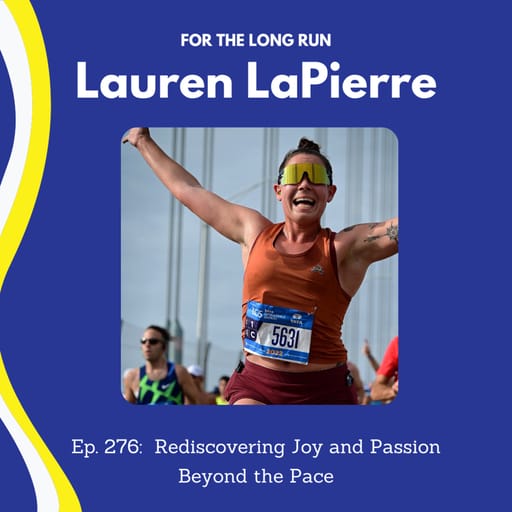
Transcript 0:00 [instrumental music] I think back then I thought it was, like, a really healthy way to, like, prove myself, but I think over the last 15 years of being a runner, I've realized so much that, like, it, it was really helpful and a motivating extrinsic factor initially to, like, get me into the sport and really kind of make me continue to push myself. 0:23 But later down the line, it really backfired because it became more about validating others versus validating myself, and so I needed to kind of remove that intention from my running and remind myself, like, what I felt when I was running and how empowered that made me feel. 0:39 Um, so now running is purely because I enjoy it and it's not to prove anything to anybody. Welcome to For the Long Run, the podcast exploring the why behind what keeps runners running long, strong and motivated. 0:51 I'm your host, Jonathan Levitt. Through personal and professional connections in the running world, I have the privilege of getting to know some amazing athletes. 0:59 I've always been fascinated by the psychological aspects of running and what helps people to achieve success, however they define it, and this podcast is aimed at exploring this and much more. I hope you enjoy. 1:11 As a New Englander, I'm always excited to see brands from the area who are doing good in the world and doing good for our running community. That's why we're thrilled to say that this episode is sponsored by Darn Tough. 1:21 Started, manufactured and headquartered in Vermont, and they're still family-owned, bringing us awesome socks to keep our feet feeling warm and dry. 1:29 You may know of Darn Tough for their durability and warmth, but did you know that they have a whole line of running socks to keep you staying dry and comfortable for the long run? 1:36 Darn Tough's running socks are incredibly durable, especially in high-wear areas. They're made with breathable mesh, are ultra lightweight, and they're incredibly comfortable. 1:44 You might be thinking, "Aren't their socks made of wool? Won't they be too hot on my feet?" 1:48 Well, it turns out that merino wool socks are perfect for keeping your feet at the ideal temperature and dry, regardless if you're running in the cold or hot weather. In fancy words, wool helps with thermo regulation. 1:59 I've been a fan of and running in Darn Tough socks for years now, and we're stoked to work with them to bring great gear to you, too. 2:06 Get a pair of your own at the link in the show notes, and be sure to use the code FTLR-BESTSOCK10 for 10% off. 2:13 A good friend once said to me that sharing your goals publicly not only inspires other people, but it also helps you to stay motivated to get after it. Basically, shoot your shot and do it loudly and proudly. 2:24 So this July, I'll be trying to break five minutes in the mile. Thankfully, we've teamed up with Puma to support a local event here in Colorado called the Mile High Mile. 2:33 Organized by Boulder Road Runners, the Mile High Mile represents everything we love about running: community, cheering each other on and pushing ourselves to go after big goals. 2:42 This summer, we want to encourage you all to dream bigger and share those dreams out loud. 2:46 Whether it be breaking a certain time goal, going after a big trail somewhere in the mountains or gearing up for a big race, all dreams are important. 2:54 If you're in Colorado, join us to push yourself at the Mile High Mile. You can register for one of the available heats in the show notes. 3:00 We'll be sponsoring a specific heat to support runners who are trying to break five minutes in the mile and will be paced by professional badass runners. 3:07 We're also sponsoring the pro race and contributing to their prize purse. 3:11 If you're not in the local area, get ready to see some awesome and inspiring content about this event and what it means to dream big, go after your goals and what we can learn about ourselves and each other along the way. 3:21 Thank you to Puma for supporting the local running community and global running world at large. We are proud to be partnered with such an incredible company. 3:29 If you're in the market for new running apparel or shoes, use the code FORTHELONGRUN for 20% off any run or train apparel or footwear. We are proud to announce the newest sponsor of the podcast, Skratch Labs. 3:42 Skratch Labs is a local Boulder-based sports nutrition brand known not just for their awesome sports nutrition products, but for their love of science and the community. 3:50 I'll share a bit more about their products and how I use them, but for now, thank you to Skratch for supporting the podcast. 3:56 Skratch will be a partner of the podcast this summer, and as always, supporting the brands that support the podcast helps to keep this machine rolling. 4:03 You can use the code FTLR20 for 20% off all Skratch products through their website via the link in the show notes. And welcome back. I have Lauren Lapierre joining me on the podcast. 4:21 It looks like she's in a lovely, uh, cabin. Um, Lauren, thanks so much for taking some time to chat. Thank you. I'm super excited to be here. 4:29 Yeah, my, uh, one of my friends termed it the cabin in the hood, uh, here in Rhode Island, so [laughs] Nice. Where in Rhode Island? 4:37 Uh, I live right on the border of Coventry and West Warwick, which is a little bit of, like, a sketchier area. So Coventry, nicer. West Warwick, eh, sometimes. [laughs] Got it. Cool. 4:49 Well, it's been, uh, it's been beautiful out there, um, the last couple of days, I think, and, uh- Yeah... more, more sunshine ahead just in time for the Boston Marathon. Yeah. Well, we're excited to dive into it today. 5:01 Before we go too far, who is Lauren? I was thinking about this 'cause I knew this question was gonna come up. 5:08 Um, and Lauren is very passionate, driven, um, she's pretty resilient, and she's very loyal, uh, which all comes in handy when you're a runner and a running coach and a running rehab specialist, so... 5:24 So let's talk about you as a runner first, and we'll dive into all the other hats that you wear. Um, when did you go for your first run? Uh, I started running when I was 12 or 13 years old. 5:36 Um, I was pulled into it by a friend who, at the time, I was kind of, like, going through an antisocial phase and she was like, "Come, join, make friends, and, like, get a little bit of physical activity." 5:48 And I stuck with it after that. 5:51 I absolutely just, like, fell in love, and initially part of it was because a lot of people told me was I, I wasn't built for running and that I wouldn't last, and I kinda wanted to prove them wrong. 6:01 [laughs] What was it about the, those first few strides and miles that felt so good?Uh, I think it was the quiet of, like, being in your own head, and I think it was just being out in nature. 6:14 Um, cross country was, like, my first love and still is. Like, I wish I could do that more often. I have an affinity to trying more trail races going forward because of that. 6:26 Um, but I think, yeah, it was, it was getting to be in the quiet. 6:29 It was getting to be in nature, and it just provided a release, I think, to a lot of, like, anxiety and stress that, like, you don't realize that you're going through as, like, a teenager. 6:42 [laughs] And you don't know how to, like, put words to your emotions yet, and I think that's where, like, it really helped me during those times. Cool. 6:48 And how did the aspect of I wanna prove people wrong, this is for me, um, talk to me more about that. Ooh. Uh, so I, like, have... 6:58 I think back then I thought it was, like, a really healthy way to, like, prove myself, but I think over the last 15 years of being a runner, I've realized so much that, like, it, it was really helpful and a motivating extrinsic factor initially to, like, get me into the sport and really kind of make me continue to push myself, but later down the line it really backfired because it became more about validating others versus validating myself. 7:26 And so I needed to kind of remove that intention from my running and remind myself, like, what I felt when I was running and how empowered that made me feel. 7:36 Um, so now running is purely because I enjoy it, and it's not to prove anything to anybody. How did that evolution happen? [laughs] Um- We're just starting with the, the easy questions today, right? 7:47 [laughs] So the evolution of that, oh, God, it really- Talking about your pre-race food. I'm kidding. [laughs] Um, that's an easy one. I know. Like, that's the easiest question. [laughs] That's the point, yeah. 7:59 There was, there was some dialogue on Twitter the other day that was like, "Podcasts don't ask hard questions, and it's boring, and nobody wants to hear the thousandth time of the same question answered." Yeah. 8:09 And that's my goal, right? Like, there are places- No, that's one of the reasons I love this podcast- Yeah, thank you... is because, like, it makes you think. [laughs] Right. 8:15 I had a, a conversation with Adrian McDonald on the podcast on Sunday, and he's won Leadville 100 Miler twice, and he's had a bunch of media as a result. And he was like, "You actually made me think, Doug." 8:29 [laughs] I enjoyed that. And I could see- Yeah... his, like, wheels turning when I was asking him these questions. And it was funny 'cause nobody's ever asked him hard questions it seems like. 8:38 And- I mean, I feel like they're ve- pretty standard questions that they ask, like, the winners- Right... at the end of, like, the race. I mean, like, or- How did you feel at mile 80? Yeah. It felt fucking awful. 8:46 [laughs] What do you think the answer's gonna be? Actually, he said he felt pretty... He s- he said he felt pretty good, but anyway, back over to- Runner's high... 8:52 yeah, over to you and, uh, a runner's high for 19 hours or 18 hours. Yeah, exactly. Yeah. [laughs] Or 16, whatever. I haven't experienced that yet, but maybe one day. [laughs] I've, like, a couple hours of it. 9:02 Anyway, um, talk to me about the evolution of that relationship with, with running, right? The reason I ask is I think a lot of people come into the sport for similar reasons or not. Mm-hmm. 9:15 Um, and then they're presented with like, "Well, but you don't look like a runner." Mm-hmm. 9:20 And, and rectifying that, and I'm good friends with Kelly Roberts, and, like, watching what Kelly does and making people feel like they belong is a- Mm-hmm... 9:29 fascinating experience and, like, what we all should be aspiring to do, which is, like, make people feel like they belong, because they do. Yeah, absolutely. 9:37 Um, yeah, so I mean, if you look at me on a starting line from, like [laughs] the time that I was 13, starting running to now, like, I am 5'2". 9:47 I, I build muscle really easily, and so, like, I just, I look stockier than, like, your average distance runner. And so, like, 9:57 I can't tell you the amount of times, I mean, even I trained for college for multiple years, and, like, the strength and conditioning coaches thought I was a sprinter for, like, the entire time that I was on the team, though I always walked in with the distance runners. 10:11 And I'm like, "How did you not realize [laughs] that I was a distance runner? I was always with that part of the team." Um, but they just assumed because of the way that I looked. 10:20 And I think my evolution to realizing that, like, it needed to become about me was during my high school career, I had an amazing coach that was super supportive, and, like, we're still really good friends to this day. 10:32 And, like, she believed in me, and that gave me a lot of, like, self-confidence into myself. 10:37 But when I went into college later on, I had a really hard time going into a D1 school, which was my goal, and I was super proud that I was able to get onto the team, but it wasn't the experience I thought it was going to be. 10:51 Um, and I think that ended up, like, forcing me to kind of seek, again, validation again from the people around me versus thinking that it was enough in myself to just be on the team and perform. 11:06 Um, and so I think... 11:10 And I also kept on kind of getting, like, those feedbacks from the people around me that, like, again, like, I didn't look like a typical runner, um, and I should be running with these people, not these people. 11:22 And so I, I just had a lot of drive at that point to kind of prove people wrong that, like, "No, I, I do belong here." And I think it came after college, after I took a actually three-year break from running. 11:36 I started training for a marathon, and my first marathon I qualified for Boston, and it was amazing. 11:42 Ran Boston the following year, and then I, I didn't re-qualify at Boston, so I was like, "I gotta do it again," and I ended up DNFing my third marathon. 11:51 And that was, like, the breaking point that I needed to actually, like, kick me out of that because I had such, like, a trigger-shy, like, moment after that point to actually being afraid to do another marathon, so I was like, "What if I fail? 12:05 What if all of these things that people said about me are true, that I don't belong in this sport? Like, this is my first time never finishing a race." 12:14 And I just had a coach tell me to, like, at that time I was running with the Heartbreakers in Boston, um, and Dan Fitzgerald, who is the head coach, he was just like, "Just show up. Just come to practice. 12:27 Do the workouts. Run with people, and, like, when you feel ready in your heart, like, you will know, and you will be ready to, like,Actually sign up for that marathon, and he was right. 12:36 And so I stopped making it about proving and getting better and making progress, and, like, all those things are great and I still wanna do that, but I made it more about showing up, being present with the people around me, being present for myself, making myself feel like proud that I just, like, did a five-mile, like, crazy devil workout [laughs] in the commons. 12:58 And, like, that was what kind of re-inspired me to be able to then start to work on, like, extrinsic goals again, once I was able to kind of really find that intrinsic motivation that I had of I, why I love running so much. 13:15 Whoa, that's a lot right there all to unpack. [laughs] Um, I... 13:18 First of all, I'm really glad that it did take us this long to have this conversation because the last minute of what you just said is exactly what I need to be hearing right now. 13:26 I'm taking a break from heavy training, and I don't know when I'm going back. And hearing you say you just knew, like, that's very helpful. Mm-hmm. It's very helpful to hear, um, selfishly. 13:38 It just, it just, like, comes, and I've done it so many times now. 13:41 And I think giving yourself that permission, and I talk to my clients about this all the time, I, I, my runners, like, giving yourself that permission to take that break is, like, it's such a weight off of your shoulders. 13:54 And I don't know why we feel this way because, like, this sport is probably the one sport that, like, everybody has this opportunity. Like, there's always gonna be another race. Yeah, totally. 14:03 There's always gonna be another opportunity for us to go back to it if we want to. So you have that ability to take a step back and, like, focus on something else and then return to it when you're ready. 14:13 Like, it's normal for, I think, our emotional capacity when it comes to, and physical capacity when it comes to running, and also mental stamina with it, to falter sometimes and us to need to, like, pull back a little bit, take a break. 14:29 And then when we've spent some time doing maybe some other things that we love, spending more time even just with, like, family and friends and, like, having that social outlet, because that sometimes gets sacrificed when you are training a lot, um, you then realize, "Oh, I miss this, and I like, I like the structure, and I like the, the time I get to spend by myself doing this, and I like the, the hard work that I get to put in." 14:51 But it can't be 100% [laughs] of the time because that's, that's what ends up creating burnout. Did, did Kate pay you to say all of this? [laughs] No. [laughs] No. 15:02 I just, I just recorded a podcast of my own podcast, um, on mindset and, like, stress management. So, like, and I had a conversation with one, one of my runners yesterday about, like... 15:11 He was like, "I don't care what's, what it's gonna take. I'm just gonna, like, pull myself across the line no matter what." And I'm like, "But, like, let's unpack that because, like, that's not... 15:19 Like, we can't be risking our health to, like, get across the finish line. Like, we need to, like, make sure there's a balance there of somewhat." 15:27 So this, like, whole mindset side of things is, like, really top of mind for me right now. [laughs] Totally. Me too. Um- [laughs] It's, it's fascinating. 15:36 So I've been on, like, an unstructured period of running for the last, I don't know, three and a half, four weeks, and- Isn't it nice? It's ni- it is really nice. And, like, a co- some of the weeks I'm running 20 miles. 15:47 I ran 45 miles last week, um, most of that all in the long run, [laughs] and- [laughs] Or half of that in the long run pretty much. 15:55 Um, and it's just like, when people message me and be like, "Oh, do you wanna go for a run?" I'll go for a run. Mm-hmm. And otherwise I'm doing two miles with this guy, and- Yeah... 16:06 and his, his pace and, and duration is, is what it is. Mm-hmm. And, like, sometimes two miles is great. Um, I wanna go back to something that you said earlier. 16:17 Maybe we'll come back to this conversation, but I, I can't let this one go. Um, you qualified for Boston in your first marathon. I did. So have you thought about the fact that 16:28 you've also thought about the fact that people have an incorrect assumption that you're not a runner, but you did something that- Most people don't do... most people don't do in their entire running career. I know. 16:42 But they aspire to do it. Like, it took me four years to do that. Um- Mm-hmm... have you thought about that? 16:49 I think, like, it's, like, I, it's, like, something that's, like, slowly, like, continued to, like, remind myself of that. 16:55 When it happened, it just was like, "Oh, it happened," and, like, that's, like, that was the goal. And you move on and you, like, make the next goal. 17:00 Um, ironically, like, I then went into Boston and was just like, "I'm just really happy to run it," and, like, didn't really think that I'd... 17:07 My plan was just to, like, hopefully re-qualify, but it was the year of, uh, it was 2018, so it was the year of the nor'easter, so it was terrible. Um, I was only four minutes off, [laughs] but I couldn't- Wow... 17:18 I did not qualify the second time. Yeah. Um- They should've given, like, a six-minute buffer on that race. I know. But anyway, so it goes. That's what my stepdad said. 17:25 [laughs] Um, but yeah, it was, it's something that I, I guess, like, I probably should take more time to, like, congratulate myself on. 17:36 And, like, I'm literally looking at, like, my plaque from that year that, like, my parents bought me to remind me, and, like, me crossing the finish line and then like, "Yeah, I did that." 17:43 Like, and I, I qualified for that on my first round, and, like, that was incredible and also, like, was also probably the worst marathon. 17:51 Aside from DNFing, that was probably, like, my worst training cycle, and fueling and ev- like, everything was terrible. But I feel like you can get away with so much when, like, it's just, like, your first time. 18:03 [laughs] And then that's, it's the second and the third and all of the others after that that you have to dial in a lot more. But I still can't get over the dynamic of you did something that... 18:16 Like, do you use that as fuel for yourself when you wanna, like, if things are hard or, or you're coming back from a break or something? Like, I, to me, I, I find 18:27 so much value and power in the first and only BQ that I've had. Um, like I said, it took me four years to get, and I'm super proud of- Right... the execution- Yeah... on that day.... over anything else. 18:42 And I ran 2:59:40, and I hope that I would've been just as proud if I ran three hours and one second. [laughs] But it's just like a, I don't know, it's a weird, it's a weird thing to 18:55 work really, really hard for something and then have it actually happen. Mm-hmm. 19:00 Um, I talked with a lot of objectively successful athletes who have been to the Olympics and won gold medals and all this kind of stuff, and often they're not afraid of failure, they're afraid of success, and like, okay, then what? 19:13 What's next? Exactly, because, like, the bar just keeps getting higher and more, like, unattainable. And, like, I, I have those conversations, too. And I think that's, 19:24 as, like, monumentous as it was to get into Boston, and, like, I was super proud of that, I, I feel like I've only... 19:33 Like, I have objectively gotten better since then, um, even though, like, I haven't had a ton of races since that point that have, like, proven that. Like, I've been after a 3:05 marathon for, like, the last... 19:44 Like, I was training for that for, I qualified for Boston again in 2019, was training for it in 2020, and I didn't, I was not a part of the virtual world that, like, did virtual marathons. 19:57 Like, I could not get on that train. Um, kudos to all the people that had that mental capacity, but I did not at that time. 20:03 And so I've been trying to train for, like, a 3:05 for the last couple of years, and I haven't reached that yet. And so, like, when that happens, that's gonna be, like, so gratifying to, like, finally get there. 20:15 Um, but again, when you get there, you're like, "Oh, shit." [laughs] Like, now, now I have to- Now what? Yeah... like, try to get a little bit faster. Now I have to maybe try to go for sub-three. 20:26 Like, this already hurts enough. [laughs] And so, like, the people that, like, I have friends that run hella faster than me, and I'm like, "I have... You, you're another animal," and it's, "You are, you're amazing. 20:37 Like, you're so inspiring because of that." [laughs] Yes, and. 20:41 But, like, I, so I've had people on the podcast who have run 2:00 teens in the marathon, and then I had, um, India Cooke, who talked about chasing a sub-seven hour marathon at New York City Marathon. Mm-hmm. 20:54 And it's like, it's, it's all about the process a- of achieving a goal. 20:59 I've joked before, and I got blasted for it in a review of the podcast, about, like, the only goal that matters without context is breaking two hours, a world record. Mm-hmm. 21:12 And so I said this initially because I was running Boston one time, and everyone's like, "Oh, what time are you shooting for?" 21:19 And I could say three hours, I could say four hours, I could say five hours, and no matter what I would say, people would be like, "Oh, hell yeah, that's awesome." Mm-hmm. And so my point, my point is- [laughs]... 21:30 that without context, the, that number is without meaning to other people. Yeah. It's certainly meaningful to you, and I think that was the reason that I got blasted for, 'cause I said, "It's me- it's meaningless." 21:41 And the guy was like, "Oh, my goals are meaningless? That's wrong. I disagree." No. [laughs] What I was saying was- Yeah... 21:46 like, you can only appreciate a random number that's thrown out if it's- It's something meaningful to you, that you've put out there... right. You've made it this objective, like- Exactly... 21:57 nebulous thing that you need to attain to. Right. But, like- Unless it's Kipchoge. 22:01 [laughs] Again, [laughs] reverse to that, I have so much respect for my athletes that are running, and, like, that do five-hour marathons, that do four-hour marathons. 22:10 The har- So I ran New York this past year, and I don't know what it is about major marathons and me, but there's always, like, crazy weather, and this past year was record heat. 22:20 And the hardest part for me was when I had to mentally kind of decide in that race, like, I can either keep going at the pace that I'm going and, like, try to finish and end up in the med tent with heat stroke, or I could pull back and just, like, enjoy the ride and, like, focus on all of the love and the support that was, like, outpouring that day. 22:42 Like, New York, like, showed up, and it was, like, amazing. I was, I was really amazed. Well, 'cause it was a beautiful day out. [laughs] Yeah, [laughs] exactly. It was the perfect day for spectators. 22:51 Um, but that was the hardest part for me, because as soon as I, like, made the decision to, like, slow down and stop, I was like, "Well, shit, how long am I gonna be out here for?" 22:59 [laughs] Like, how long am I gonna be on my feet for? 'Cause I've only trained for the mental capacity of being on my feet for X amount of time, and I've never gone further. 23:09 And it's made me start to rethink, like, next time I do a marathon, like, maybe I need to do it differently. 23:14 Maybe I need to, like, plan for things to go awry, and, like, plan and do a run just for time on feet for, like, X amount of hours. 23:23 Um, because that was the hardest part for me, and I, I just ended up focusing one mile at a time, and that got me to, like, my family. 23:31 And then I focused on getting to my family again, 'cause I had them, like, meeting me at two spots, and then I was close to the finish and I was like, "Okay, I can do this." 23:38 [laughs] I had a similar experience, um, once at Boston and once at CIM, and both times I was shooting for, like, 2:57- Mm-hmm... and I ran, like, 3:35 and 3:43. 23:52 And it's just like, it's bizarre to have a race feel so hard that's, like, 45 minutes off of your PR. Yeah. [laughs] Um, and to have the base case- That's literally what it was for me at New York. 24:05 I was, like, everybody was, like, 40 minutes off of where they wanted to be that day. Yeah. That's a lot of time in a marathon. Yeah. [laughs] Um, how did you come back from that race? 24:16 Um, so because I pulled back so hard, um, like, at the 15K mark I was just like, "All right, I'm done. 24:23 Um, I'm just gonna walk and drink water, and mosey [laughs] essentially to the next water stop," which was every mile. 24:31 Um, I took the week off like I normally would, and went for an easy, like, 20-minute run on the Friday after, and, like, I felt 100%. And I was like, "Well, I apparently did not race New York. 24:46 I ran New York," and I, I can say that. Like, there's a difference between racing and running. And so I personally ran New York City Marathon. I did not race New York City Marathon. 24:56 And-At that point in time, I was like, I had done so much work to try to achieve my goal of, like, the time that I was like, "I feel a little bit cheated. I wanna just try again and see what happens." 25:09 Um, so I ended up trying to... I continued my training cycle, and I went on to train for Houston Marathon in January, at which point I got food poisoning on the day [laughs] of Houston. Classic. 25:22 And so I had to pull out again at the 10K mark. [laughs] No, at the 15K mark. So I ran 10 miles of the race. My heart rate was at, like, 180 that entire time. 25:32 Um, and yeah, after that point, I was just like, "Okay, it's not my year for the marathon. We're just calling it." [laughs] Nice. Um, I had a f- an entirely different experience after CAM this past year. 25:44 I felt like I was run over by a truck. Oh, no. And I was more sore from running that marathon, again, like 45 minutes slower than my PR, more sore from that than, like, almost anything I'd ever done. [laughs] Oh, God. 25:58 Like, including rim to rim to rim, including, like, real big mountain efforts, and I think that was 'cause I stopped fueling, like, super early on. I was gonna say, what do you think it was? 26:10 Well, I, I was puking for 12 miles, so, like, nothing stayed down. So I, I basically, like, did a fasted marathon. Okay. So if you're thinking of doing a fasted marathon, don't do that. 26:18 Um- I just did a fasted, like, six-mile run the other day, and I was like, "You know, I think the reason people don't like running is probably because they're doing it fasted." 26:26 [laughs] [gentle music] If you've been enjoying this podcast and can spare 90 seconds of your time today, can you do me a favor? Can you pop over to Apple Podcasts and leave a review? 26:37 It helps other people find and enjoy the podcast too. Thanks so much. This summer, it's time to go after bigger dreams and goals. 26:45 We're excited to be partnering with Puma to support a local event here in Colorado, the Mile High Mile. 26:50 The running community in Colorado is incredible, and this event will highlight athletes from all ages chasing faster times on the track, going after personal records for the mile. 26:59 The For the Long Run podcast team is sponsoring a Breaking Five minutes in the mile and will be joined by professional athletes to help pace us. 27:06 Personally, Breaking Five has been on my mind for years, and I'm finally going to try and go for it, and yes, it's here at 5,000 feet. 27:13 [laughs] If you're local, join us at the event, whether in the Breaking Five heat or at one of the other heats, or as a spectator. 27:19 It's going to be a great event, a gathering of our running community, an opportunity to support each other and witness people pushing through their limits. You can find the registration links in our show notes. 27:29 But if you're not local, stay tuned for some inspiring content on social and YouTube. 27:34 We hope this event and the concept of pushing past limits will help you dream bigger and go after your own goals with renewed motivation. This summer, dream big and go after those goals. 27:44 We are proud to be sponsored by a local Boulder-based sports nutrition company that we all know and love, Skratch Labs. As you may know, last year I went to their facility here in Boulder and got a sweat test done. 27:54 They were able to tell me how much salt I'm losing during a workout and recommend sports nutrition from there. 27:59 Long story short, I'm a salty sweater and need to replenish perhaps more than the average person, but that's not all. About a year ago, I started working with sports dietician Kylie Van Horn. 28:08 Kylie is the owner of Fly Nutrition and a coach within Microcosm. I was having a lot of GI issues pre-run and during the run, so David, my coach, suggested I work on nutrition with Kylie. 28:18 I switched my nutrition pre-run to purely liquid fueling, and while that didn't solve 100% of what I'd been dealing with, it sure has helped. 28:26 Fast-forward a year and more, and Skratch's products have helped kept me fueled and energized through plenty of strong workouts and long runs, as well as some big adventure days in the mountains. 28:35 Their super high carb mix is exactly that. It's full of what you need and goes down super smooth. When you give your body what it needs, you'll truly enjoy it for the long run. 28:43 You can grab energy bars, chews, hydration mix, recovery drink mix, and super high carb drink mixes for your big days from Skratch to fuel your training and upcoming adventures. 28:52 I use the lemon lime super high carb mix every single day. I use a half serving within an hour of all morning runs, and it's my main fuel source for w- road long runs. 29:01 For trail adventures, I use a couple servings in my bottles and supplement that with the chews or other fun trail snacks. You can use the code FTLR20 for 20% off your order at the link in the show notes. 29:12 Thanks again to Skratch for supporting the show. Oh, and we're back. The internet didn't like us talking about fasted running. 29:26 [laughs] Which is a- Be fueled. Yeah, be fueled. [laughs] Stay, stay, uh, stay fueled, my friends. Um, anyway, I think that's a good commentary on, on fasted training. 29:39 [laughs] It's, uh, most likely not good for you- No... particularly if you're not a man, and, um, moving right along. [laughs] Yeah, fasted running is not great, especially for females. [laughs] Um, okay. 29:54 I wanna jump back to the conversation we were having around taking a break, and I'd love to hear more about why that conversation is super top of mind for you at the moment. You said you just recorded a podcast on it. 30:06 You were talking with an athlete about it. Mm-hmm. Tell me more about, tell me more about that. 30:10 Um, so I, like, with taking a break, like, I just see things with running, I think, a little bit less rigid than I think what I grew up with, like, high school and, like, the three seasons and training during the summer. 30:26 And now that, like, I'm an adult and I, I run for fun, I don't have all the time in the world and I don't get paid for it, and [laughs] I have bills and everything else that I have to worry about and responsibilities, I just, I see how life sometimes will ebb and flow with my training, and there's going to be seasons of my life, like right now, that I am spending more time running and spending more time training, and then there's gonna be other seasons of my life where that's not gonna happen as much.And that's okay, and I think a lot of what we are taught or thought to have happen is, like, constantly make progress, constantly m- move forward, and I don't think that that always has to be, again, the top-of-mind goal of running. 31:11 I think you can be happy right where you are if you are learning something in the process of actually learning to be still, and I think that's something that I'm currently learning and enjoying is, like, being present in this moment and being present with where my life is right now. 31:25 Like, can I be happy in that? And it's not just with running, it's everything. Um, but running and choosing to kind of step away from some of those goals sometimes helps me to do that. 31:36 I talked with a friend on an episode of this podcast in March of 2021, I think. Um, it was the first episode that had a, a musical intro from Brian Walters of Single Track Sound. 31:51 And Tanzy, in this episode, talked about an analogy where you're holding an egg. You're holding an egg, and the egg is your goal, and you can squeeze the goal, but if you squeeze it too hard, it's going to get crushed. 32:06 Mm-hmm. 32:06 And this is, like, exactly what you're saying, and I find it so fascinating that some of us squeeze that egg so hard that we destroy it, and some of us are able to figure out a way to, like, lightly hold the egg and keep it visible, and you can see it. 32:25 Sometimes it's there, sometimes it's not, but you're, you've never, you're never gonna crush it. Mm-hmm. And I find that balance of, like, gripping the egg just hard enough to- That's a beautiful analogy... 32:34 to be really hard. Yep. Isn't it? [laughs] Yeah. I love that. [laughs] Um, so I'm curious, how do you help your clients... 32:45 First, talk to me about the work that you do, and then I'm curious about how you help your clients use this new, new analogy that you've just, uh- Yeah [laughs]... or new metaphor you've just learned about. Um, so yeah. 32:56 I am a runner rehab specialist and a running coach. 32:59 I am a doctor in physical therapy, and I own my own business called The Personalized Running Doc, and I, I have two separate programs, one that is primarily for people that have had a running injury, whether that's a chronic or an acute thing, and that are looking to get back into running. 33:17 Because something else that I was chronically plagued with when I was in college was running injuries, and I didn't understand why, and, um, kind of people just gave up on me, and at the age of 22, I was told, "Well, maybe you should just stop running." 33:30 And I was like, "That can't be the answer. I'm 22 years old. Like, what are you talking about?" 33:35 Um, and so I've, I've since, like, essentially devoted my life to making sure that that's not the answer other people are being told in this sport because it, it's usually not. Um, 33:45 I, I haven't met a client yet that I haven't been able to help get back to running. 33:49 So that is one program that I have, and then the other program is more, like, my monthly coaching where people have, like, performance goals or, like, consistency goals or whatever it may be, or even just, like, improving their fueling and nutrition around running. 34:04 Um, I give them kind of, like, basic advice on those things in, in a coaching capacity. 34:08 So I have, like, those two separate programs that I work with people, and yeah, I mean, a lot, uh, it's really dependent upon the person in front of me in terms of diving into mindset and anxiety and stress management and all of those things 'cause some people are a bit, like, walled up, and they do not wanna talk about those things. 34:25 Other people, like, if I see that the, the conversation is flowing, I see that they're getting comfortable with me, they- we've built rapport, um, I start to broach it, and I'm like, "Hey, I'm kind of just sensing this, and this is just some of the things that I'm, like, pulling out from our conversations. 34:40 Are you comfortable with us talking about that?" And I just try to listen for the most part and let people talk as much as possible when I'm with them. 34:49 And then I've had a lot of, like, personal things that have gone on in my life that I think have given me a really good perspective. 34:56 I've also been in therapy for three years, and I've learned a lot from my therapist, and I think that that's what now helps me become so attuned to other people's stressors and anxieties that I can just, like, feel it, and I, I just try to give people tactics that I have learned, um, that have been helpful, and if I feel like it's even farther from, like, that, I'm like, "Hey, this is a lot that you're unpacking right now. 35:21 Like, one, are you talking to a professional? 'Cause, like, I can only go so far, um, in supporting you as a coach. 35:26 But if you're not, are you open to me, like, giving you, like, options for you to talk to, because this is super important?" 35:33 And I've learned in talking with my therapist how much the outside of my life, those other 22 hours of my day, all the other things that are going on in my life, how much that was affecting my training and how I was showing up and, like, my race anxiety and all the stress that I put on myself in running, this perfectionism mindset, was due to all of these, like, other background things that were going on, and I had no idea that they were connected until I started, like, diving into it and talking about it. 36:03 It's fascinating. Can we, can we maybe, like, triage a live situation? Oh, yeah. [laughs] Are you cool with that? I don't care. [laughs] I think the- I'm super open... 36:11 the reason is, A, I'm, like, currently going through this, and B, I think a lot of other people, I think it'll resonate with a lot of people. So okay, so here's the scenario. Work is busy. Life is busy. 36:23 Relationships are challenging. Um, family always wants more, and- Mm-hmm... I'm a workaholic, and I can't do, um, I always wanna do more. Mm-hmm. And podcast is busy. Work is busy, et cetera. Yeah. 36:40 Um, and running becomes, uh, it's not additive. It's, like, becoming a stressor. Mm-hmm. Where do you go [laughs] with something like that?So like my fir like my question would be like what do you want to do? 36:57 Like what is, in your ideal, what is the thing that you want your life to look like? Like what is your best life gonna look like and how, how do you get yourself there? 37:07 So it's again like creating like a goal and then building back from that. I never like I'm like, "Oh, you absolutely need to do this." It's more kind of like a conversation of like, "All right. 37:16 What's, what's your capacity right now, and like where do we go from there, and how do we build that?" So like that would be my first question, like what do you want your life to look like right now? 37:25 So where that led to was I stopped running- Mm-hmm... just like entirely for a week maybe. Mm-hmm. And I let the pendulum swing far towards the other stuff. 37:38 And like you said, you talk about like we all have a capacity for X amount of stuff in a day. Mm-hmm. And I was like, "The bucket's being filled with other stuff. I can't, I can't fit running in right now." 37:50 And to me, I was like super frustrated by that because in the past I've used running as an outlet, and running became a stressor. Yep. And it w- it was not, it was not adding. 38:01 And so I was like, "Okay, I need to remove running as a, as a stressor," and now I'm trying to figure out how to add it back in as a, as a like functionally beneficial thing that is also fun. 38:13 But like it's still stressful, right? Oh, yeah. Like it's physically stressful. It, it does damage to our body, and that's why we get better. That's what adaptation is. Yeah. Um, and so that's... 38:25 I don't, I don't prescribe to or I don't claim to have any answers- I-... um, or know that I'm on the right track, but I feel like I'm closer to getting, getting there. Yeah, I mean, 38:36 the fact that like you, like you said, you're right now kind of just like going with the flow, and you're either running like maybe a couple miles with like your dog and like that's great or you're just running with friends. 38:47 Like that's usually my advice when I say like if you're coming back to it, like do it when you want to do it and like how you want to, how you want to 'cause like that's, that's the only way that you're gonna know that you're doing it for the like love of it. 39:01 And like I completely understand when like we're using running as like an outlet for your stressor. And like the last month of my life has been like very, very crazy. I've had, uh, my grandmother was on hospice. 39:14 She passed away, like family drama, family stress, all of these things all at once and like last minute travel plans and moving around clients and all of these things that just like happened all at once, and on top of that, like financial stuff. 39:28 And so like running easily could have been just like the tip of the iceberg that like just put me over the edge. 39:35 Um, and I think, again, I'm very in tune to myself, so I can only like speak for myself, but during those times, like I was probably prioritizing more like downtime and pulling myself away from other situations that maybe would have like taken more energy from me. 39:52 And did that like impact maybe some of my relationships at the time? Yeah, it definitely did, but that was what I needed to do to like keep myself sane. 40:01 And then running was still something that I had the capacity for at that time because of that. That being said, like it, it was getting there. It was very, very close to like just boiling over. 40:11 Um, and even last week, like some, again, stressors happened, and I was just like, "You know what? 40:16 I'm just not running two of my days that I was supposed to run," and like decided I'm gonna, I'm gonna strength train instead because that made me feel better in that moment. 40:25 That was gonna provide me a different release than running was going to be. 40:29 And I don't think we think about from like a physical perspective, yes, running is stressful on our musculoskeletal system, like in our, our lungs, our cardiovascular system. 40:42 Running is also super stressful on our nervous system because of just the amount of movement that's happening, the amount of vibrations that are going through our system, and that's what makes... 40:52 Like people think about running and like biking and like they're like, "Why are they so different if they're like such like a lower body thing?" 40:58 Running, you're, you're just constantly bouncing, and that vibration, those perturbations are extremely tiresome for your entire nervous system through your, your entire body, where for biking, your upper body is relatively stationary and like your legs are doing the work, and there is no bouncing, so you're not getting the same level of nervous system fatigue. 41:18 There is still some, but it's not the same, and that's why they can be so different, um, and why you can have a different capacity on a bike versus running. [laughs] I, I don't know- Sorry, I went on a tangent there... 41:29 I don't know what to say. I love this. Um, 41:33 I feel like it's the kind of stuff that like everyone's like, "Yeah, yeah, yeah, yeah, I believe it," and then you just need to hear it enough times or maybe just go through it yourself in order to actually believe it. 41:43 I think it also comes with like training age that like the longer that you're in the sport, the more just like forgiving you become to yourself and the more understanding. 41:54 And like again, explaining people like the different capacity that you have as your training age gets older. 42:00 Like my training age is relatively old [laughs] for me because I've been running for such a long period of my life, where most of my clients are older than me but have a lesser training age. 42:12 So I can get away with actually a lot more. 42:15 Like I can go out and run 20 miles tomorrow no problem because I've had so much underneath my belt that has gotten me to that point, even though I'm not training at that level right now. My clients could not do that. 42:27 But I also have the ability to like give myself more grace and compassion and like understanding because like I've, I've DNF'd twice now, and I've run from the mile to the marathon. 42:41 And I've seen all of the in-betweens and like all of those things and the training that has gone into that, and I've seen how as I've gotten older, even though I'm not sure I've gotten like so much faster, I feel my training has gotten so much more comprehensive and better. 42:56 And I feel better and more confident in myself because of those things versus the things that you get away with early when you start training.Yes, totally. 43:06 Um, I definitely agree on the, like, ability to go out there and just rip a long run one day. 43:11 Like, last weekend I ran 18 miles, um, with my girlfriend 'cause she wanted me to run with her, and I was like, "Okay, I feel pretty good, so let's go." 43:20 [laughs] Um, and I felt pretty, like, tired the next day, but none- none, you know, lesser for the wear or whatever that saying is. Um- Tired you would feel for running 18 miles? 43:30 [laughs] No, I, like, felt pretty decent for running 18... Like, yeah, as you would expect after running 18 miles. Yeah. But I hadn't run that far since November, and that was March. Um, 43:42 going back to what you said earlier, I found it super interesting the difference of, like, hard times in life with running and in and out of running. 43:54 In 2019, I was going through, I had just, um, ended a relationship, my grandfather was dying, and my running was the best it had ever been. And I was doing therapy, I think, weekly. Mm-hmm. 44:05 And I had a conversation with my chiropractor, who was, like, doubling as my secondary therapist on these weekly, um, appointments. Shout out to Brian Kent of Forward Spine and Sport. You're amazing. 44:17 [laughs] Um, and he was like, "Man, you're- you're progressing because running is just running for you. You're doing the work in other aspects of life and- and, like, doing that mental work." 44:30 And [laughs] I'm just like, "How do I get back to that place where I'm doing the mental work and other..." 44:34 Anyway, um, it was, it's just an interesting dichotomy between, like, the experience of summer, spring/summer 2019 and- and this period of running. And to your point, it's like, it's not ever the same. Mm-hmm. 44:47 You have to give yourself grace, and perhaps I'm a little more wise four years later. And you're like a different person. 44:56 Like, you- you- you're the same person in terms of, like, I remember there being, like, this beautiful thing where, like, it talked about how when you're aging, and I'm maybe thinking of this 'cause my birthday's actually [laughs] this coming weekend and I'm turning 30, and, like, they were talking about how when you're 30, you're still your 12-year-old self. 45:17 You're still your 13-year-old self, 17-year-old- Oh, I'm definitely my s- 12-year-old self still. 45:20 [laughs] Like, you're still the combination of all of these ages, and, like, you are, but you're a different person than when you were back then because you've had all of these ages that you have now become into one. 45:34 So you're not just one number. You're a combination of all of these things. And so yeah, you two years later, you're a combination of two more years, and tho- those years have, were crazy. 45:45 [laughs] From, or no, you said 2019, so four more years. Two years- Yeah, the years were crazy. Yeah. Yeah, those years were crazy. [laughs] The years keep coming, and they don't stop coming. 45:54 [laughs] So, like, we- I know. [laughs] We're just like, like honestly, I feel like I lost, like, the last three years of my life. I'm still like, "What year is it? How old am I?" I think I'm still 26. 46:06 Like, and that was [laughs] where I was before- It's 2019, and I'm 24. [laughs] Which the math doesn't work, but- Yeah. 46:12 [laughs] So, like, it's- it's still being back in those ages, and it's just, I think because life, so much of life has happened and so much of it was just, like, in front of us the last couple of years especially, um, and I think all of us are still kind of unraveling the social implications that happened during that time. 46:31 Like, we're still coming down from that high because even last year there were still, like, those surges that people were getting really scared about, um, and there were still, like, certain periods where, like, things would have to, like, we would have to be masked and things like that. 46:45 And I mean, even in doctor's offices, like, they're still for the most part masked, it, or, like, somewhat masked. And so, like- I mean, I still wear it on airplanes. Yeah. 46:55 And so, like, it- it's just something that I think we're still collectively absorbing, like, the trauma of that and all of that information. 47:03 And so that, I think we kind of almost negate how much, because now we're like, "Oh, it's past it. It's fine. We're moving on." 47:11 And it's like, but we haven't really talked, if we are, if we haven't talked about it yet, and there's been other things that have happened in life also during that time, which again, all of us had individual lives that were happening during that time, there's probably a lot to unpack, and I think that's one of the reasons for me personally, like, I feel really strongly in myself right now and, like, confident and in a good place because, like, I just so happened to start therapy right as COVID was happening. 47:37 [laughs] And so I was like, "Cool. This is a really good time." [laughs] Love that journey for you. Um, we're gonna need to call this the, For the Therapy Session. [laughs] For the Long Therapy. 47:48 Um, yeah, shout out to therapy. [laughs] It's fantastic. It is. It's great. Um, I started it when I was a kid, and then I got back to it in 2018 and have been doing it, like, twice a month- Awesome... 48:01 basically ever since. Um, super valuable. Um, okay, so someone's listening, and they're like, "Well, I have a coach, but I really like what she's saying. How can I work with her?" 48:12 So I do free discovery calls for anybody interested. Um, you can go onto my website, thepersonalizedrunningdoc.com/schedule. 48:22 Um, and we can, on those calls I essentially chat with people about their running experience, their injury history, and their goals, and from there we kind of figure out which of the programs are best for you, like, what are you looking for right now? 48:35 Are you looking for pain management and returning to running, or are you looking for, like, coaching and training side of things for performance? 48:43 Um, I also do have a, like, strength training program that I launch periodically, and so that, the next one will be launching in June. 48:52 Um, but it kind of depends what gets brought up in those conversations where I direct people, and I have different, like, scaling payment plans, um, that are available for people depending upon what they need and what they're looking for. 49:07 Cool. This has been awesome. I'm glad we got to chat. Uh, where can we find you, uh, outside of your website, but on your corner of the internet? 49:14 Um, I am The Personalized Running Doc on Instagram, so @thepersonalizedrunningdoc, and if you wanna say hi, just shoot me a DM. Awesome. Thank you so much, and, uh, we'll see you out there. See you out there. 49:29 That's it for today's episode. Like many long runs, it's sad when it has to end. I hope you join in next time on For the Long Run, and in the meantime, happy trails. 49:38 If you enjoyed this episode, it would mean a lot to me if you shared it so that others can find it and enjoy it too. This podcast and the accompanying music has been produced by Brian Walters of Single Track Sound. 49:48 For the Long Run's logo was created by Vanessa Wolf of Sterling Wolf. Show notes have been written by Ruby Wiles and is managed by Emily Holland. It takes a village. 50:00 [outro music]