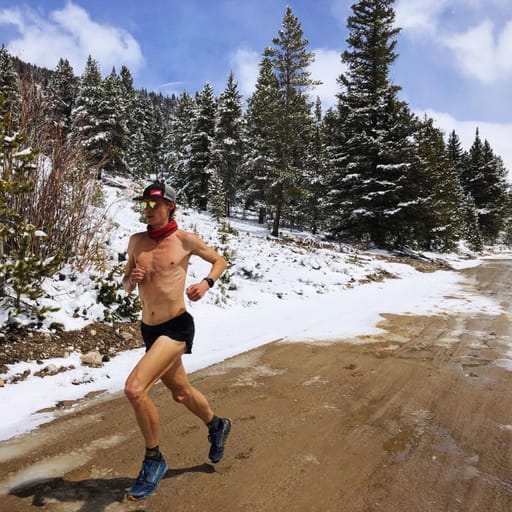
Transcript 0:00 [upbeat music] Yeah. Being able to 0:14 boil things down to the particular action you need to take is a valuable skill set, and one that I think running has really given me. 0:27 Welcome to For the Long Run, the podcast exploring the why behind what keeps runners running long, strong, and motivated. I'm your host, Jonathan Levitt. 0:35 Through personal and professional connections in the running world, I have the privilege of getting to know some amazing athletes. 0:41 I've always been fascinated by the psychological aspect of running, and this podcast is aimed at exploring this and much more. I hope you enjoy. 0:53 This episode is brought to you by Lyric, to help enable everybody and every body to feel better every day. Lyric is a therapeutic massager and home wellness companion. 1:03 It's designed for display so you won't forget to use it, and it looks beautiful on any coffee table. It even includes an accessory handle to find those hard-to-reach places so that you can massage your back by yourself. 1:14 Grab yours today for $199 at national retailers like Target, Best Buy, Bed Bath & Beyond, or REI, or get free shipping online with the code FTLR at experience lyric.com. 1:32 Have you guys heard of Beam? I have been absolutely loving their products lately. 1:36 Beam is a CBD company that's making waves in the running world by offering products that combine THC-free CBD with other high-quality ingredients. 1:45 It was founded by two ex-professional athletes with the idea that everyone should have the chance to experience what better feels like. Whether you're sore or stressed, Beam is key for recovery and self-care. 1:56 Try it for yourself with 15% off using the code FTLR from beamtlc.com. I recommend Beam Dream powder or the Focus capsules. 2:06 [upbeat music] Welcome back. 2:21 I have Kyle Piattari joining me here in Boulder, Colorado. Kyle, thanks for taking some time to chat today. Hey, John. Thanks. So the first question is always a tough one. Uh, who is Kyle? Who is Kyle? 2:35 To sum Kyle up, he's a guy who runs ultramarathons, has three young kids, has a spouse of over 10 years, and cares a lot about doing well at all those things and, beyond that, trying to be a good person. 2:53 That's a good recap. So the Kyle I know, or knew, was the version from Boston, where you were running Harvard Stadium with a child on your back. 3:04 Now, for those who, who haven't known me for a few years, I got into fitness from this crazy group called November Project, where we'd run stairs at Harvard Stadium, and these are steps, not just, like, little foot stairs. 3:17 And so, I don't know, it's, like, two and a half feet up, and it's hard enough- It's a legit workout- [laughs]... doing these stadiums. So it- Don't undersell it, John. Yeah, yeah. 3:27 No, I, I'm, I'm trying to oversell it here. It's very hard without a small human on your back, and you were doing it with a person on your back. Usually your child, sometimes not. 3:39 I remember, and, and this was way before I was aware of what running ultras were, so I was like, "This guy's just doing crazy stuff." So that's sort of setting the stage. 3:48 I'm sure we'll get to that, but let's back up even further and talk about your first run. Do you remember your first run? My first run? Wow. 3:58 I think my first race was what we called Olympic Day at my elementary school in kindergarten, and it's at the end of every school year. And I think at least half my class was out with chicken pox. 4:11 I had already had and recovered from my own bout of chicken pox. Ah, immunity. [laughs] Yes. That's how it works with some viruses, apparently. 4:21 So on Olympic Day, I ran, like, all the different events, everything from, like, 40-yard dash, 50-yard dash, 75-yard dash, and I won everything. So I just came home with this massive stack of first place ribbons. 4:35 [laughs] And I thought it was a really big deal, and I don't think that's a good thing. I think I had way too much of a competitive mindset, even as a six-year-old. And yeah- S-... 4:47 I guess I've had some success since then, but that might have been my, my most competitively successful- [laughs]... day of running of my life. Will you ever top that? No. Okay. We can just end the interview. 4:58 [laughs] No, I'm just kidding. Um, so between your, uh, six-year-old sweeping victory of every--what was your school called? Montebello Elementary School. 5:08 So your sweeping victory of Montebello Elementary School, where I'm sure your name is still plastered in the cafeteria of best running performance ever. It should be. [laughs] I'm sure it is. 5:20 Um, and now, what did that process look like for you, particularly the beginning of that process? So that definitely made me think I was a pretty good runner, again, from age six. 5:31 [laughs] And- I mean, situational awareness is important. [laughs] Yeah, I guess so. I guess so. And then I got into cross country in middle school. My older brother was doing it, so I was drawn to it. 5:44 I knew I was gonna do it, and I had a lot of tension choosing between that and soccer as a kid in the fall season. And I went with cross country 'cause I realized I was better at that than I was at soccer. 5:55 And I wasn't super good, but I, I was, I was pretty good in middle school and then in, in high school, and didn't run in college. Tried to do it recreationally. 6:05 And long story short, I really struggled with motivation and learning how to be a runner, how to get myself out the door every day when I didn't have a school team forcing me to be doing it every day.I was not successful for at least five years, getting into my early to mid-20s. 6:26 Then I took a paper route in Duluth, Minnesota. This was in 2000, 2011, and I realized I could do it faster if I was running. [laughs] So I ran a paper route every day. 6:38 This would be, like, from 3:00 to 6:00 in the morning when it's, like, 20 below zero in the winter, January through April. 6:45 And being out every day and being forced to, I was able to develop the mental framework for being a consistent runner. 6:54 After that, I moved to Colorado and learned about the trail ultra scene, went out and met with some groups, and then signed up for my first ultra. 7:02 I, by then, I already had the framework for being a daily runner, and that was the most important step in my running life. And then you could say a weight was lifted when you stopped the paper route. 7:14 [laughs] Yes, until I put the, the child on my back- [laughs]... at the Harvard Stadium, fast-forward a few years. So why did you sign up for your first ultra? Oh, you know, got mixed up with the wrong crowd. 7:28 Met some people who were bad influences. [laughs] Developed some addictive tendencies. In short, I met someone who had run the Leadville 100. [laughs] His name is Drew Warnke. 7:37 And I met him at the Denver Trail Runners group. This was in 2011, I think. It was shortly after I moved to Colorado. And I'd read Born to Run, the gateway drug for a lot of people, especially back in that time- Yep... 7:50 and really wanted to try it. And I'd been thinking I was gonna do some marathons, and then I just kinda skipped that. So you went 40-yard dash to ultra, which I, we've had on this podcast numerous times before. 8:05 What did that first finish line, sorry, second finish line, the first ultra, feel like? First ultra finish line was a really big deal to me. It was a 50K. The course was a disaster for various reasons. 8:18 It's a race that only existed for one year, and they had a lot of difficulties due to weather and course rerouting. Anyway, in short, I, I finished first, which I thought was a big deal. I ran it in Vibram FiveFingers. 8:31 It ended up being, like, 37 miles- [laughs]... on slickrock in Moab. I was a total wreck physically by the end of it, but it was so immensely satisfying. And I finished it thinking, like, "This is a life highlight. 8:45 This was so extraordinary, so amazing. I don't think I'll ever even need to do this again." [laughs] "I got it out of my system, and this is such a great achievement. 8:56 You know, I think I could just walk away from this whole running thing now and, and be forever happy with how this went." And did you? [laughs] That's not how it played out. 9:06 [laughs] I don't remember how long it took, but, uh, certainly within, like, three months I'd signed up for the Leadville 100 for the following year. Wow. What was it about that race? 9:17 Was it the, the crowd you were running with? Yeah, yeah, and just mixed up with the wrong crowd. [laughs] Some people who were bad influences. 9:24 So you have to have a pretty s- decent reason to, or maybe you don't, to commit to running 100 miles. But I have to ask about the 50K. Did you puke in the 50K? No, I did not. And I don't think I ever have. 9:38 It's more of 100-miler thing. Got it. The, the comment is in regards to every time I've seen Kyle at a race, it's involved projectile vomiting. But you didn't have that this year at Western States. Is that correct? 9:51 That is not correct. Oh. [laughs] I puked shortly after Michigan Bluff. I was there, and I told my crew, "I don't really wanna puke here th- again this year." 9:59 So I held back on drinking fluids a little bit, and then as I was running out of the aid station, I got gutsy 'cause I was like, "Yeah, keeping my stomach settled through Michigan Bluff." 10:10 [laughs] Took a few more swigs of my Maurten, and within, like, a quarter mile of being past the aid station, it all came out. 10:16 [laughs] And then after Cal 2, I puked right out of the aid station, which I've also done in the past, that exact spot. And this is, like, enough that every single runner behind me in the field- [laughs]... 10:28 is gonna step in it. [laughs] 'Cause this narrow single track, there's no way to avoid this puddle. [laughs] So that was twice during Western States this year. And then the finish line, it happened as well. 10:40 So I'm five for five for puking on the track at Placer High in Auburn after finishing the Western States 100. We'll get to Western States, but, but yes, I've never seen such joyous removal of, of [laughs] 10:56 stomach fluids [laughs] as I've seen with you. It's just like you know it's happening, and it's gonna happen, and then there it goes. 11:04 It's a lot more joyous at the finish line than it is when you still have to go another 44 miles afterwards. Got it. We're gonna move on to cleaner topics. Talk to me about lining up for your first 100 at Leadville. 11:17 My first 100, I was scared, and I was properly and appropriately scared because the whole experience was pretty, pretty intense, pretty damaging to my body, and something that I really needed to treat with a lot of respect, otherwise things could have gone really poorly. 11:37 It went okay. Let's see. I, I paced myself fairly well, but I still blew up. And I w- I was under-trained because I had had some injuries and stuff, but I wanted to get to the finish line, and I did pretty successfully. 11:48 But I got to this deep, deep, deep meditative, intense, almost out-of-body experience in the final 10 miles where all I could think about was breathe in, breathe out, one step, two steps. 12:04 And there was nothing in the world that existed outside of my next breath or two and my next step or two. 12:11 And it was in this extremely intense state for however many hours it took me to slog it into the finish line.And then the time after crossing the finish line, things got even scarier. 12:23 I was terrified about how badly I might have wrecked my body. Now that I have more experience with these things, I can just deal with the pain and suffering and realize I'm probably gonna be okay in a couple days. 12:34 But I was terrified. [laughs] It was so scary. And I'd also over-hydrated, which is a rookie mistake, and I had to pee more or less every 45 minutes throughout that entire next night. 12:47 And when you're so sore that you can barely even roll over lying on a bed- [laughs]... it is really hard to crawl out of your friend's pop-up camper and go pee on the sidewalk. [laughs] Repeatedly throughout the night. 13:01 I would just roll my body and then just kind of slide down the stairs. It was really bad, and it was scary 'cause I didn't know what I'd done to myself. 13:09 And once all of the fear and pain has subsided a little bit, then the whole in- intensity of the experience is what you remember, and there's nothing else like it. 13:19 There was no other experience in my entire life prior to that that had been so intense and gotten my mind so focused on one thing to the pure exclusion of all other things that you could possibly think about. 13:33 That's when I realized I'm gonna have to keep doing this. [laughs] But isn't it fascinating where, like, in the moment, everything was hard, and it brought you back to basics of this is the only way forward. 13:45 I had a friend who I reconnected with that I went to elementary school with on the podcast, and we talked about the metaphors between running and life or the connection between running and life. 13:56 In these moments in running when it's hard, the same way we get through that is the same way we can get through, like, a hard day of work or a hard day with a relationship or anything that's hard. 14:07 It's like you don't eat the elephant all at once. Again, sorry vegans. You eat it in bites, and you, you take bites out of the elephant. Or you talk about building fitness one brick at a time. 14:19 I think that these reminders are so important, and I think it's why, I know it's why runners are more successful at life than I'd say the average person. Yeah. 14:31 I'll add to that and say that as a lawyer, what you do is you break things down to their constituent parts, and you think of individual arguments about every component of a broader issue or problem or question. 14:47 You break it down. And I think that the runner mentality, especially the ultra runner mentality, is very applicable to law practice as well for that reason. I think it's applicable to any, any practice. Agreed. Yeah. 15:03 Being able to boil things down to the particular action you need to take is a valuable skill set and one that I think running has really given me. So Level 100, you did that. You were utterly destroyed. 15:17 I resonate with the, uh, how do I get out of bed to pee again. 15:21 Um, my experience of being totally wrecked comes from when I did Rim to Rim to Rim, and I consumed way too much caffeine in gel form in those 13 hours, and I was laying... We were camping. 15:34 I was laying on the ground facing the wrong direction, and my quads were pulsing, and I was like, "I need to pee, and I can't move." [laughs] Such an awful feeling. 15:43 [laughs] But- I'm just shuddering, picturing- [laughs]... what you were like at that moment. But it's so satisfying in the same way. Like, I got destroyed by a long run yesterday, and, like, my legs were like... 15:54 You know the feeling. Like, they're just heavy, and it's lovely. What's wrong with us? [laughs] Yeah. Oh, I've been doing this for so long now. It's been almost 10 years since I ran my first ultra. 16:05 That was October of 2011. And at this point, I don't think I know how to feel satisfied with anything unless I've, like- Unless it's hard. Yeah, unless I've really worked myself. So do you think that's a good thing? 16:20 I think it can be, but learning to f- take satisfaction from things without any extrinsic input, and, and here I'm talking about, like, physical pain being an extrinsic motivator, though it's also intrinsic as well 'cause it's yourself. 16:41 I think that can also be a bit of a problem. For example, like, yesterday, I went for a run, and I'm tapering now for Run Rabbit Run, which is in six days. I'm gonna run 100 miles. 16:50 So I o- I only ran eight miles yesterday on a Saturday morning, and I finished, and I was going through all my typical routines of what I do after a long Saturday morning run when I'm just totally trashed and fatigued and sore. 17:04 And then all of a sudden, I'm like, "Wait, I don't even feel sore or anything." [laughs] "W- what do I do with myself?" [laughs] I have three more hours in my day today. [laughs] Yeah, and I feel good. 17:13 Why do I feel good? And I felt weird about feeling good. But then I was super productive, and I did all this yard work that I've been putting off- [laughs]... 17:21 the entire summer 'cause every weekend, I'm always too tired to do it from all my long runs. I don't know what the takeaway there is other than- [laughs]... 17:29 maybe, maybe realize that you can be successful without pushing yourself to the point of being completely destroyed. Sure. Yes. But I think that anything valuable takes some struggle, right? 17:42 I had Molly Seidel on the podcast a few weeks ago, and she just won a bronze medal in Tokyo, and- Good interview. Anyone listening should check it out. Thank you. It was, uh, it was a fun one. 17:52 But we talked about the fact that her, her roller coaster of a, of an experience, like, the highs and the lows, they make each other. And the highs wouldn't be as high or as poignant without, without the lows. 18:06 And I guess in your situation, the low can be the discomfort and the puking and all of this stuff. But I think things would be boring if they weren't hard. I agree. I fully agree. 18:18 In fact, I have a, a little sticky note that I just hand-wrote, "No beauty without struggle," that I can see from my desk. 18:26 And when I have to work late nights or push myself extremely hard in my jobI take a similar perspective to how I view my running, and if I'm feeling fatigued and really struggling to some extent to keep going forward and keep being effective, then in some ways that means, that means I did my best, and it's satisfying, and I wouldn't be able to f- to feel that way if, if everything always felt easy. 18:56 One of the things that I find fascinating is people who do the work without people seeing the work. 19:03 You do this literally, you know, training at home or training in the dark or training solo or with your kids, and then you perform in public. 19:14 And I, I think that the, like, uh, I don't wanna say hidden training or just, like, the work that happens behind closed doors can be really motivating for people, and then others, like, thrive on the group training or sharing the journey or, like, with training partners or groups or whatever. 19:31 So talk to me about where you fall on that and how much of what you do is out of necessity versus you prefer it that way. Yeah, really good question. 19:41 And I would say where I'm at now is in-- is interesting, but I'll step back. I used necessity to get to where I am at now. 19:49 By that I mean I signed myself up for really challenging races while having a demanding schedule with work and parenthood, and I was forced to be put in a position of just do whatever it takes to get it done, and that meant a lot of run commuting, a lot of late nights on the treadmill after the kids are asleep, a lot of, you know, 4:00 AM alarms on the weekend so I could get in the long run after working past midnight the night before. 20:19 And that was out of necessity. It's really hard to will oneself to do that unless you have to. 20:24 So if you just stack enough on your plate to where it's sink or swim, then you really find out just how strong of a swimmer you are. So having done that for years, I find that it's just become habit. 20:38 So at this point, even when it's not out of necessity, I can still succeed in pushing myself really hard because I built the framework to do so, and I used necessity as a tool to get there. 20:51 So now when I go and train, it's almost mindless, and I typically do what I-- a lot of people might think of as boring runs. Like, I'll just do hill repeats for hours on the same hills, the same trails. 21:03 I, I don't explore trails very much. 21:05 I just go to the particular spots where I know I can get the right workout in, and I just go up and down, like on Mount Falcon or Green Mountain, not the Green Mountain in Boulder, the one near Denver. 21:16 And that's what I find works well for me, and it's almost mindless. It's just whatever's gonna make me most successful in my mind, that's what I do. The thinking is almost out of it because it's become routine. 21:27 What does success mean to you? Oh, we're going into the deeper questions now. [laughs] Well, we had to- I don't know how to answer that question... 21:34 we had to lay the foundation for 20 minutes, and now we can get into the good stuff. Okay, you're making me go deep here. [laughs] What does success mean? I don't even know at this point. 21:43 I just keep doing this, and I don't even know if I should. 21:47 It is demanding to, to be a competitive ultrarunner with a lot else going on in life, and I'm not sure I would recommend it to most other people to try and train so much if you're pretty busy and have other life obligations. 22:01 To me, I think success means doing all that in a way that can maybe inspire other people. 22:09 Not inspire other people to do things so extreme as, like, getting your treadmill workouts at midnight when you have a 5:00 AM alarm to finish a work assignment, but inspire people to realize that if your life's kind of difficult and your schedule's not absolutely ideal for ultratraining, maybe you can still run 30 miles a week and go do a 5K every now and then, for example. 22:35 So setting high expectations for oneself is a way to get the best out of oneself. 22:41 So what I'm trying to say is I feel successful if by pushing myself really, really hard I can set an example and show that maybe everybody can push themself hard as well to the extent they want to. How old are your kids? 22:56 My kids are seven, six, and four. And how do they feel about basically what you just said? Do they see that yet? I don't think so. I think they're still too young. 23:05 But they're certainly growing up in an environment in which their parents run every day, and they see people being really active and I guess not settling for a slow type of lifestyle. We're, we're doing stuff a lot. 23:21 One of the things that I find different about your approach is, or I guess the internet would call it conventionally different, um, you're very involved as a dad, and your kids are involved in your workouts. 23:36 Your kids are involved in your life in so many different ways beyond just being a parent. Talk to me about that. Yeah. Part of that is the necessity thing. 23:46 I've done probably well over 2,000 miles with jogging strollers in my ultrarunning training career and done a lot of runs while watching my kids on the treadmill, which is-- can be really stressful. 23:59 [laughs] Um, it's not something you really wanna do unless you- Have to [laughs]... have to. 24:04 [laughs] And then I would say that, this is a bit of a tangent, but probably my most proud and stupid and crazy daddy miles run I've ever done was I ran a full marathon at a track while my kids were playing on the infield of the track. 24:20 [laughs] And I would interact with them every single lap. So I just wanted to see if I could do it, and I did, and the kids had a great day. It was a huge success. 24:28 Um- And you ran, like, a three-hour marathon or something, right? [laughs] I was-- I don't know. With s- with stops, it was probably over four hours. There were a lot of stops. Oh. 24:35 [laughs] I think I, I think I changed wet pants twice or something. 24:39 So some of that is out of necessityAnd I kinda like that I've been forced to have to do that if I wanna get in my training, because, you know, necessity is the parent of creativity, as they say, kinda. 24:52 And being creative about my training is actually one of the things I get pleasure from. 24:58 One thing that keeps it interesting and fun and new, as opposed to maybe just doing the same type of workout routine week after week. 25:08 And I think I'd probably be more successful as a runner, more fit, competitive, whatever, if I had more conventional training. But again, the creativity part is fun. 25:18 So yeah, involving the kids, sometimes I just do it because I want to see them be exposed to it as well. And so that, that's a whole other component. 25:26 And yeah, being able to go for a two-mile run with, with a, you know, a seven or younger-year-old kid and see them really enjoy it is super rewarding. [upbeat music] Thanks again to Lyric for sponsoring this episode. 25:41 Lyric's Rhythm Therapy is designed to help every body and every body relax and temporarily relieve pain. 25:48 As the miles have continued to grow this marathon season, using Lyric has been a great way to effortlessly help with some good passive recovery in between sessions. 25:57 Get yours today for $199 at national retailers like Target, Best Buy, Bed Bath & Beyond, or REI, or get free shipping online right to your door with the code FTLR at experiencelyric.com. 26:11 Thanks again to Beam for sponsoring this episode of the podcast. As the days start to warm up and get longer, a cool-down routine in the evening becomes even more important. 26:20 Did you know that you can get a subscription to Beam's Dream Powder? It's what I use most nights before bed to help with a refreshing night's sleep. 26:27 When you subscribe, you'll get the Dream blend with a bunch of perks, like even better pricing, free shipping, a free mug, and a drink frother just for signing up. 26:35 Dream helps me wind down at night, and it's made with compounds like melatonin and magnesium that support a better night's sleep. 26:41 Make sure to use the code FTLR at checkout for an extra 15% off the already discounted 20% off monthly rate. And now back to our conversation. 26:56 How would your seven-year-old answer the first question that I asked you of who is Kyle? Oh, she would probably make up some fantasy story about green eagles and bobcats and, uh, um, a mechanical underwater shark. 27:13 That's what she's been talking about a lot lately. Cool. That's, that's fun. We should have that interview, too. [laughs] Yeah, I don't think you expected me to say anything like that, did you? 27:20 [laughs] I definitely didn't. No, I, so I find it, I find it fascinating. I thought at first the... Honestly, I thought the, the weight training with a child was for, like, training purposes. 27:32 I di- I was, I don't know, 24 at the time. I didn't think it was out of necessity. It was my ignorance showing, I guess. But it's, it's fascinating to hear how necessity drives action for you. 27:43 I think one of the things that I think makes runners different than others is that the majority of people are too comfortable in life, and I don't mean that in the, like, people with, um, you know, they don't know where they're gonna get their food. 27:59 They're, they don't... 27:59 I, I mean people who are, who are going to work, who have a family, and, like, are in the same routine day in and day out who don't run, or they don't have something that they're striving or attaining as, like, a North Star. 28:13 Like, they don't necessarily have the same struggle that we choose to have, right? We're choosing to do this. You're choosing to get on the start line next week and run 100 miles above 9,000 feet. That's a choice. 28:26 I think that the struggle and the, like, needing to fit it in a busy schedule, like, I think that makes us better. Not better people, but better individuals. Yeah. 28:37 I think that running is not the right answer for everyone, or maybe not even for most people. 28:43 But yeah, certainly having something that you kinda commit to and then have to build your life around and, and, you know, push yourself a little bit to make happen is a positive thing. 28:54 I certainly get that myself from signing up for crazy races that I'm gonna, like, die doing- [laughs]... if I don't train well for. 29:00 [laughs] And I, I guess that ties into what I said about showing my kids, sort of having an active type of lifestyle, just putting yourself in a position where you have to be creative and make things happen and, and not always be so comfortable. 29:15 So Run Rabbit is Friday? Correct. How are you feeling? I'm feeling good, I think. [laughs] What does good mean? What does good mean? 29:24 In a taper, good means that you have things figured out logistically, and nothing's too sore or injured feeling, and you can look back at your training and say, "At least on paper, I should be fit." 29:38 [laughs] I can, I can do all those things right now. So Friday, is it a noon start? Yeah, the noon start is brutal. [laughs] The morning waiting for that start is mentally challenging. 29:52 I like the Western States 5:00 AM because then just get up, get ready, and then go. But the noon at Run Rabbit is a mind fuck. I'll just use the F word there. 30:02 [laughs] So there's, there's an 8:00 AM start and a noon start. Is that correct? I think it's 6:00 AM. Got it. I, 6 or 8. I can't remember. So the two categories, tortoise and hare, is it? Tortoise and hare, yeah. 30:13 Got it. The elite category and the, I guess, the non-elite category. So it's 11:58 AM, uh, Mountain Time on Friday. What's going through your head? 30:26 Probably by 11:58, I'll be feeling great and excited to start, but at, like, 11:50, I'll be, like, nervous, and let's just get this thing going. 12:01. 12:01, I will be feeling fantastic. 30:41 It will be such a relief [laughs] to be started running. [laughs] 12:02. 12- I'm ju- I'm just kidding. [laughs]12:02, where am I in the field? [laughs] Time to be in a competitive mindset. 30:53 How am I against my competitors? Who- Should I push the pace here? Who went out too fast? Is anybody puking yet? Um, going into the first evening, or going into the evening, how do you approach getting into the night? 31:06 Okay. So Run Rabbit is different from the other 100-milers that I've done. For competitive runners, front pack runners who aren't used to running through the night. 31:16 So at Run Rabbit, what's going through my mind at that point is, "Okay, Kyle, do not screw up your gear logistics. 31:23 You gotta make sure you have light when it's dark out, and have the right layers in case it gets cold, 'cause this thing goes way up high in the mountains. Overnight, the temperature fluctuations could be severe. 31:36 And make sure I have my eye drops," because, like, a lot of runners in these mountain 100s, especially Run Rabbit, for whatever reason, people get corneal edema and lose their vision. 31:45 [laughs] And I'm putting eye drops [laughs] in my eyes periodically during the race. I learned that the hard way from having done the race before. Wow. [laughs] I forgot about the cold aspect. 31:55 I feel like I saw you at, like, midnight or 2:00 AM. It would've been mile 60-something, and you were wearing a singlet, and you were so cold. I don't even remember that. 32:07 [laughs] I was probably, uh- You were eating gummy worms or something like that. 32:11 Yeah, I was probably just so far gone by that point mentally that I was incapable of forming any, uh, f- re- retaining any memories in my brain. Got it. But it sl- sounds like it probably happened. 32:26 [laughs] You weren't puking, but [laughs] you won that year, 2019, if memory serves me. What did that feel like? Winning Run Rabbit in 2019. Okay. I'll s- I'll say two different things. 32:39 First, it felt really gratifying because it was the first major race that I've won. I think of Run Rabbit as the second most competitive 100-miler in North America, after Western States, of course. 32:50 And, you know, some years maybe Leadville or, or Javelina or, or something else, Tunnel Hill maybe, Flat One, could be more competitive. 32:58 But for the most part, I think of Run Rabbit as, as the, the second most competitive. And getting the prize money was, was really great. It's a pretty s- huge purse, huh? It was 15 grand. [laughs] That was really great. 33:10 Yeah. Do you think about that at all during the end of the race? Yeah, definitely. It's just o- one of many things you can use to motivate yourself. 33:18 At that point, you're grasping for straws, coming up with any motivator you can to just be willing to suffer a little bit more, and that's one that's certainly, uh, certainly available to grab at. 33:31 So it was gratifying, and I- Did you get a big, fat check, like a physically large check? We had a big check. [laughs] Yeah. I didn't take it home. It's for photo ops. 33:41 But, uh, the check that mattered was normal check size. But on the other hand, it was also just no different from any other 100-miler finish. 33:52 If you run 100 miles, this is the way I think of it, you probably put yourself so deep in the pain cave that getting to the finish line feels like an immense accomplishment. 34:03 And it doesn't matter where you finish in the field. It doesn't matter if you're first, doesn't matter if you're last or anywhere in between. 34:09 In fact, it might even be more gratifying if you're last because it was probably harder. You were out there longer. You probably suffered even more. 34:16 So this is a sport in which literally every finisher has already, like, maxed out their emotions. 34:23 So when you're already maxed out, getting some external validation, like what place you finished, almost can't change the experience because you are already feeling things as intensely as you possibly could. 34:38 So it s- it felt like just another 100-miler finish in a lot of ways. Two hours later, then what? Oh, total train wreck. [laughs] Yeah, being up all night, puking. Run Rabbit, I, I don't even like to think about it. 34:54 I would say that the final five or so miles of that course are the most physically destructive on the human body- [laughs]... of any ultramarathon, because you already have, like, 98 miles on your legs. 35:06 The course is long. It's like 103 miles, and then you have this epic downhill on dirt roads- [laughs]... for like five miles. Like- You're dropping, like, I think it's, like, over 400 feet per mile, vertical feet. God. 35:18 And it just goes and goes and goes. So it's like the fastest terrain you could possibly run on in one of these things, and you already have 98 miles on your legs. 35:26 So if you're trying to race and finish as fast as you can, you're gonna have to push the pace on these. 35:31 And I was going pretty slow 'cause I was in the lead, and I felt comfortable with my lead, even though it was a close race. 35:37 Jim Rebhunck only finished, like, six, seven minutes behind me, but I didn't have to hammer it to still win the race. I was going, like, seven flat miles, whereas if I'd had to, I probably could have done sub-six miles. 35:50 But even the pace I did, my legs were obliterated by the bottom. 35:55 [laughs] And I'm talking, like, muscles buckling every step, feeling like my legs are just gonna give out under me when I'm trying to do the last mile to the finish line. What keeps you going? I don't know, John. 36:07 [laughs] I don't know. But you keep doing it. Yeah. Yeah. I don't know. It's habit at this point. I just, I just keep running ultras for reasons that I, I don't even understand at this point. 36:20 It's just what I've been doing. It's part of, part of my identity, so ingrained in my lifestyle. So that's, that's what I was saying earlier. 36:28 I used necessity in a lot of ways to make it a habit because I wanted to be an ultrarunner so badly. How come? Oh, so many reasons. I think we, we could have a whole nother conversation about that. [laughs] It's fun. 36:42 It's exciting. It's great to push yourself, blah, blah, blah. Um, good community. So I use necessity to make it a habit. Now that it's a habit, I don't know how to get out of it. 36:51 So I, I feel like I'm just gonna keep doing this till my body breaks down.And you feel good about that? It doesn't even matter how I feel about it at this point, it's just what I'm doing. 37:04 But I, I also-- Okay, I would say one of my big motivators is concerned about future regret. I'm competing at a higher level than I ever thought I could, like exceeding my wildest dreams. 37:16 I didn't think I was gonna be able to win any major races when I was first getting into the sport, and I thought it'd be incredible and so fulfilling to be, like, kinda competitive. 37:27 And then I did better at races than I ever thought was possible. And then I just got better each year that I've done the sport. 37:36 It's fun, but it's not always-- doesn't always feel like it's worth it in the moment, but, but I know that looking back on this phase of my life, I'm in my, my mid-thirties now. 37:48 In the future, I'll say, "Oh, when I was able to run that well, I wish I'd done it when I could." 37:55 So I, I don't wanna have future regrets thinking that I passed up the opportunity to race and compete and really do things that I think are fun and cool when I had the chance. Were you good at team sports growing up? 38:10 Oh, bit of a change of topic. No, no, no, it's right in the same topic. Okay. I'll tell you why I'm asking. Okay. 38:14 Yeah, I was a, I was a pretty competitive soccer kid, and, um, I didn't play in college except in-- I played a ton of intramurals pretty competitively throughout college. Got it. 38:23 That, that, um, nullifies where I was going with this. [laughs] That's okay. 38:29 No, I feel like a lot of people who find success in running, and success is whatever it means to them, for some, it's just getting better year over year, for others, it's winning Western States or Run Rabbit or the Boston Marathon or whatever it is. 38:44 I find that a lot of these people were sort of like the lone wolf, or they weren't very good at sports growing up. 38:52 Um, I ran, uh, some trails with Zoe Rome last weekend, and on Monday or Tuesday, she posted something along the lines of, on, on Instagram about, like, never feeling like an athlete and always having the imposter syndrome with team sports and never feeling like she would fit in until she found this community. 39:12 And then she discovered that she was, like, really competitive, and now she has a bunch of FKTs and leads a coaching group. 39:19 And so for her, finding running was the path to, I don't wanna say adding purpose, but adding meaning and structure into something that she didn't think she could be good at. And it's the same thing that you said. 39:33 Like, you didn't think that this process or this experience would be one that you would excel at, but you are. Yeah. Yeah, that's interesting. 39:43 I would say that that might be a more noble purpose than I'm coming at it with. So for me, growing up as a kid, playing all the sports in, I guess, a fairly hypercompetitive team sport, boys culture, 39:57 everybody thought they were gonna be, like, a pro athlete as a kid. Like, NBA, uh, whatever, whatever was your favorite sport, you were gonna do that as your career. Right. 40:04 [laughs] And I was never dumb enough to actually think that was true- [laughs]... but I think all my friends were. 40:10 But yeah, now it turns out I, I guess I'm the only one in my group of friends who could say that he's, he's a pro athlete. So I guess I sort of always had this competitive mindset of wanting to go as far as I could. 40:23 Yeah, I don't know. I don't think that's, I don't think that's a very good reason to do it. No, but it is, right? It's, it's getting better. It's how good can you be? Yeah. 40:33 Yeah, having a competitive drive is a way to do all the things to make yourself successful in anything. 40:39 So yeah, I think it ki- I guess comes down to what, what ultimately is your relationship with competitiveness and pushing yourself and just trying to be better and better and better as opposed to just not caring. 40:52 I mean, it's better than stasis or, or lack of desire to improve. Yeah. 40:59 As I said, like, I think about how I'm going to perceive myself in the future when I'm not physically able to do what I do now, and I, I want to be able to say that I pushed myself as hard as I could. 41:12 But also, yeah, sometimes I worry, will I, will I be sad that I'm not able to anymore? 41:18 And I, I hope that the answer will be, "I did all I could when I could," for in a elite competitive, uh, way, that is, "and I'm very satisfied with what I accomplished when I was able to, because I did push myself." 41:32 This reminds me a little bit of a conversation I had with Mike Wardian, who... We're getting some rain here in Colorado and- Some thunder. Yeah... some thunder. The thunder rolls. Where's Garth Brooks when you need him? 41:42 Um, conversation I had with Mike Wardian after Broken Arrow, also in 2019. I was curious why he runs so much and why he races so much. He races more miles per year than most people run in a year, maybe by 25 to 50%. 41:59 Those are just his racing miles. And- Yeah, he's crazy. [laughs] But, but I asked, I said, "Why do you do this?" 42:05 And his answer was, "Because at some point, I won't be able to, and I don't know when that is, so I wanna do it now." I love that. Yeah. 42:15 That's pretty similar to my perspective, is you can't take a future of being able to do things for granted or, or as a given. You know, you never know when you won't be able to do something anymore. 42:25 You never know when you'll die, and making the most of each, each day, each run is, is the right, right way to do things, I, I think, to get the most richness out of life. 42:34 'Cause every run could be your last, espec- especially in a, in a sport with such high injury rates. I'm pretty constantly close to being sidelined by an injury. 42:42 I have been for almost a decade of continuous competitive running, improvement, and race success. But it's, it's been close to being sidelined probably 50% of the time. You're alluding to gratitude here. 42:58 Do you intentionally practice it, or is it sort of just by happenstance?I think I aspire to practice gratitude deliberately more often, but I think that I'm typically in a position where it's not being so deliberate about anything other than get it done, given, given my lifestyle and, and how I, I guess, stack things on my plate. 43:22 And, and as we talked about earlier, I, I use necessity as a tool. So gratitude is, like, going above and beyond and, like, being a good person willfully, so to speak, and it's something I aspire to. 43:35 Uh, but I would say a lot of the time I'm sort of on autopilot and just, just figuring out how to make th- how to make things work a- as a runner at least. 43:44 But I, but I think the piece about gratitude is it sounds like it's part of an underlying why, right? You're doing it because you can, and because you can, you're doing it. Yeah. Yeah. That's a good way to put it. 43:58 If you can, you-- maybe you should. [laughs] And do it more, and do it often, and do it faster. 44:04 [laughs] Do it until you either can't anymore because you've, y- you've gotten older or you've overworked yourself, or, I don't know, you get hit by a bus and die. 44:13 [laughs] So switching gears a little bit, um- Yeah, this, this is too philosophical, John. Let's- [laughs] Let's get more tangible. [laughs] More tangible. Favorite post-race food? Oh, that's, that's not tangible. 44:29 There's nothing tangible going down- [laughs]... post-race. 44:31 So for example, after Western States this year, and this really applies to all my 100-milers, I'm so depleted, so dehydrated, so empty, and then I can't get anything down for hours because I'm so nauseous, I'm just gonna puke it up. 44:48 So I think it was, like, 4:00 AM, and I don't think I slept a, a minute after Western States this year, or the, or the, the previous time, 2021 or 2019, either running. 44:58 But I think I, I think I was awake literally the entire night after the race. Well, you have to do the doping control and pee in a cup and all that fun stuff, right? I, I didn't have to for either of these. 45:05 I, I did in 2017. I think just whatever their protocol was, I wasn't in the pool. But oh, man, that's another story. My-- g- me getting the pee out- [laughs]... it took so long in 2017. 45:17 [laughs] I, I was also giving blood for the medical, biomedical research, and they stick a needle in, nothing comes out. Right. Yeah. 45:24 [laughs] They had to get this bigger needle 'cause I was so dehydrated, I had no, like, blood flow. [laughs] So finally they stick this bigger needle in me, like the 10th poke, we had a little trickle. 45:33 And then I'm just lying there on the cot in the medical tent for like four hours until I can finally pee, and then it's the color of Coca-Cola. Um- The blood is, like, mostly goo. [laughs] Yeah. 45:44 It's, it's basic- it's basically like, you know, the, the chocolate cherry- Pretty viscous... uh, Clif Shot. [laughs] Yeah. 45:51 So we, we were going to, at InsideTracker, we were looking at doing a, a post-race blood draw, and we decided that would be too cruel. 45:58 [laughs] Y- y- yeah, you might just need to, like, take a big butcher knife- [laughs]... and just really slice someone open to get much out. Would you just pour that in here for me? Um- Yeah. Okay, well, okay. 46:10 So, so that's me after a race, and I'm puking. I can't even drink water, and it's miserable. Uh, so this year after Western States, it was, like, 4:00 AM, I finally ate the most disgusting protein bar. 46:22 I thought it was gonna taste good 'cause I hadn't had any food since crossing the finish line at, like, 10:00 or 11:00 PM, and I did it, like, one nibble at a time. It took me, like, 45 minutes- [laughs]... 46:31 to get this thing down with minimal sips of water, just trying not to puke every bite. And I did, and it was horrific. But then once my stomach settled, the best food post-race, without a doubt, is salty scrambled eggs. 46:45 Salty scrambled eggs? Yes, salty scrambled eggs. They're bliss after 100-miler. Like, sea salt or table salt? What kind of salt are we talking? I'm kind of a foodie, but in this context, like, Denny's has worked for me. 46:59 [laughs] Nice. Denny's is a low bar, just to be clear. I hear Denny's is a pretty-- yeah. [laughs] What's their tagline? That's their tagline, pretty low bar. 47:07 [laughs] I'm pleased and proud to say I don't know of what their tagline is or whether they have one. Makes sense. Moving, moving right along. [laughs] We're gonna stop knocking Denny's now. 47:16 [laughs] Sorry if anyone listening likes them. Damn it, I, I blew my chance at having Denny's as a sponsor on the podcast, but- [laughs]... maybe we'll seek IHOP. [laughs] That's an East Coast reference. 47:26 [laughs] Um, I think my last question is, fast-forward five years, what are you really proud of? You know, just, this one is, uh, you know, a, a pretty, um, esoteric question. Okay, five years. 47:44 I'll be proud of my five consecutive top 10s at Western States, which I have now. Whether I get more is TBD, but even if I don't, I'll be proud of those five. 47:57 And I will be proud that I tested myself, that I pushed myself to do something, and yeah, it's kinda dumb. It's kind of a dumb sport. It's kind of pointless. It really is, though. It's so irrational. Yeah. 48:13 But it gets back to the, it gets back to the metaphors and what can we take away from it. 48:17 Like, your getting better has been a product of necessity and putting yourself into a position where you're forced to do something in order to get results. You can take that formula and apply it to anything in life. 48:33 Yeah. Yeah. I'll be proud that I pushed myself and learned to push myself, and hopefully, if I'm past my, my elite competitive phase of my life, then I can apply those lessons elsewhere. Winning masters. 48:48 [laughs] I was thinking more like writing or cooking or being a good parent or a good lawyer. 48:57 We'll, we'll have to reconvene in, in 2026 for another episode of the podcast and, and do a check-in on all of those topics as well. All very important, of course. For the long writing or cooking- [laughs]... podcast. 49:11 For the long haul, it applies to everything. Sounds good. Cool. Kyle, thanks so much for taking some time to chat, and, uh, we'll see you out there. This was fun, John. Thank you. Of course. 49:21 [outro music] That's it for today's episode. Like many long runs, it's sad when it has to end. I hope you join in next time on For the Long Run, and in the meantime, happy trails. 49:33 If you enjoyed this episode, it would mean a lot to me if you shared it so that others can find it and enjoy it too. This podcast and the accompanying music has been produced by Brian Walters of Single Track Sound. 49:48 For the Long Run's logo was created by Vanessa Wolf of Sterling Wolf. 49:52 [outro music]