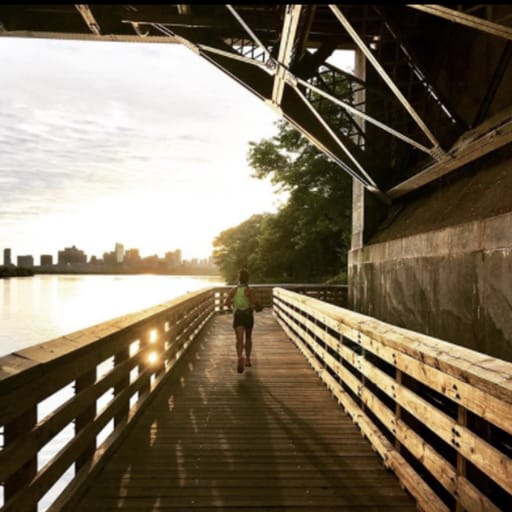
Transcript 0:00 [upbeat music] Welcome to For the Long Run, the podcast exploring the why behind what keeps runners running long, strong, and motivated. 0:17 I'm your host, Jonathan Levitt. Through personal and professional connections in the running world, I have the privilege of getting to know some amazing athletes. 0:24 I've always been fascinated by the psychological aspect of running, and this podcast is aimed at exploring this and much more. I hope you enjoy. This episode is sponsored by Janji. 0:34 Janji is a local to Boston running apparel company dedicated to exploring, connecting, and giving back through running. 0:40 Inspired by travel, informed by function, and built for adventure, Janji makes running essentials to equip you wherever you run or roam. 0:48 The company was founded on the core belief that water is a human right and donates 2% of their sales to supporting clean water organizations around the world. 0:56 I've known the two co-founders of Janji for over five years, and it's been a privilege to see them grow and increase the level at which they've been able to give back to the running community and to the world in general. 1:07 Welcome back. I have my friend Dana Bogan joining on the podcast today. Dana, thanks so much for taking some time to chat. Yeah, thank you so much for having me. I appreciate it. For sure. 1:18 Uh, first question, who is Dana? [laughs] Uh, so I am... Oh, wow, that's an interesting question. Who knew that would be so hard? [laughs] Um, so I am first and foremost the daughter [laughs] 1:36 of, uh, Teresa and David. And I guess for me what that means is that I am the daughter of an interracial couple, uh, which is important to me, um, and the youngest of four children. And I grew up in Connecticut. 1:52 I live here in Boston now. Um, and I went to Boston College, work here as a social worker, um, doing medical social work full time, and then I actually do group fitness and personal training outside of there. 2:07 So in the morning and at night, I'm always moving, and then during the day I really, really hyper-focus my energy on sort of being in the helping profession. Um, and I, I love being able to do both. That's awesome. 2:23 We got connected, uh, I don't know, what, five years ago now, through November Project. That's a long time ago. Probably more than, more than five years ago. Yeah. 2:31 Um, and it's been, it's been cool to watch your own athletic growth, um, which pales in comparison to your, um, I would say your emotional and, and mental health growth over the last couple of years. 2:50 So it's been cool to watch those sort of parallel, um, tracks. And let's, uh, I guess let's dive into that. Yeah. So given that this is a running podcast, we'll start on the running side. Sure. 3:01 And, and I'm sure the [laughs] the rest of it will, will, uh, come later. But, um, do you remember your first run? Oh, wow. So I remember, 3:15 I think the moment for me or the moments for me, my first runs were actually, um... I don't know if you remember the Presidential Fitness Challenge thing that we had to do in elementary school, and you had to run a mile. 3:28 And those would have been my first times running. And from a really young age, I could always run pretty fast. Um, and I, I just remember, like, competing with myself [laughs] and pushing myself so hard. 3:44 I was probably, like, in fourth grade and, like, killing it behind our elementary school. [laughs] And, like, that would've been, that would've been, like, my earliest experiences of running. 3:55 Um, and we did that every year until high school when there was finally an opportunity for track and we started running, you know, a little farther than the grass behind the school. 4:07 [laughs] Um, and so that's kind of where it-- I guess I would say that's where it all began. It's... 4:14 I always think of running for me as it started in the ocean, because I'm from a shoreline town in Connecticut, and so the first places I learned to run were always, like, along the water, and my high school is, like, a quarter of a mile away from the beach. 4:29 So my first runs were always, like, I ran a mile to Anchor Beach, and that felt really cool and felt like a big accomplishment. And then, you know, like, every incremental increase, it was measured in beaches. 4:44 [laughs] And so my first runs were always started at the ocean. And so any time I run now and I'm near water, um, especially if I'm by the beach, it actually feels a lot like I'm coming home to myself. 4:57 Uh, and I, I kind of love that. That's awesome. So your, your runs have evolved from beach to beach to- Yeah. [laughs]... bridge to bridge as we do here in Boston. [laughs] Yeah. [laughs] Exactly. Yeah. 5:12 Um, I-- So my running experience, I, I guess I always started as a runner, my intention was always, "I need to run so that I can be a better soccer player." Um, soccer was absolutely my passion as a child. 5:28 I started life with a ball at my feet, and I never, ever, like, left home without a ball until I was actually in college. 5:37 And so my whole trajectory of running is actually interesting because as a kid it was very much focused on, "How can I be a better soccer player?" not, "How can I be a better runner?" 5:49 Um, and when I got into high school, that was a big problem for my track coach, [laughs] uh- Mm-hmm... who kind of identified me as a potentially great runner. 6:00 And I'm, I'm very stubborn, and I was like, the more he forced running onto me, the less running I did. 6:08 And so, and I kind of was like, "You can tell me what to do, but the more you push me to do that, the less I'm actually gonna do it." 6:15 Um-And so we sort of like did this weird dance of as if he asked nothing of me, I would do really well, but as soon as there was a lot of pressure on me, I would, I would just kind of like crash and burn. Um, 6:28 and, and so it was in a way, I guess my running experience was my first experience too with understanding my anxiety. Um, I didn't have a name for that until I was many, many years older. 6:44 Um, but I look back on it now and I'm like, "Oh, I hated running in high school because it made me sick." Every time I ran, I would get sick. 6:51 I would get sick because I was so anxious leading up to it that as soon as the performance, is which is what it felt like for me, um, as soon as the performance was over, I, I was in so much pain because my body was like, you know, doing flip-flops every which way, that I would have to like curl up in a fetal position and just lay for like 45 minutes. 7:12 And it was so uncomfortable, and really nobody wants to do that. 7:16 So I really kind of pushed running to the side for a long time because I didn't understand what was happening, and no one was giving me words for that experience. 7:26 Nobody was saying, "Oh, you're, you're just anxious because this is a lot of pressure we're putting [chuckles] on you to run this race." Yeah. 7:33 And so I, I sort of pushed running very much to the side until I got to college and was no longer, you know, I was not-- I was a great soccer player, but absolutely not a D1 soccer player. 7:46 Um, and so I kind of started to venture out and was like, "There's this thing I've never heard of. It's called a marathon. 7:53 I don't know anything about it, but it sounds intense, and I like intense, so I'll start training for it." And- [chuckles]... my freshman year of college, I joined our marathon team at BC. 8:03 Um, every single distance I ran that I think was beyond six miles was the farthest I'd ever run. And, uh, yeah, that was-- It kind of took off from there. I was like, "This, this is fun." Um, 8:19 I had-- I mean, Boston was the first marathon I had ever heard of, and also the first one I'd ever run [chuckles] so like, who doesn't love running after you do that? 8:27 But yeah, that's kind of like where it started, and I guess there's a lot between then and now, but, um, that would be, I guess, the, the skeletal framework of the beginnings of running. [chuckles] That's awesome. 8:40 Um, I was going to ask, how did you get back into running? But it sounds like, um, it sounds like the progression back into running makes a lot of sense. Did you, 8:54 did you worry that you would have some of those same feelings as the distances picked up and maybe come race day, um, as the anxiety you were feel- similar to the anxiety you were feeling, um, previously? No. Um, 9:12 there was actually never a doubt in my mind that I was gonna do this. I, I have come to identify very clearly in myself that what I, I don't really-- I'm not really a coachable person [chuckles] per se. Um, 9:30 I struggle whenever anybody puts an expectation on me, and that is, that is hard. 9:36 Um, I, I sort of like, I, I don't even-- I still try to make sense of it because I'm like, there has to be a way that somebody can, can coach, even given like these mental barriers that I have up that exist for a reason and that I don't wanna break down. 9:51 But I think that when I ran in high school, I started off running the mile, and I came in and I had-- You know, like I, I come from s- a town that is not like known for their sports. Like, we were fine. 10:05 We're not the worst, but we are not the best. We don't have any special coaches. Our coaches are, you know, like the whoever super not fit teachers who were just unfortunately picked as the coach for that sport. 10:18 Like, they were not special. And so we were competing against some pretty wealthy districts around us, and that meant that those districts actually paid coaches to train their kids. 10:28 And so those kids ended up having better teams. So there was a lot of pressure on any kid in my district who was really just innately good at a sport. 10:36 There's a lot of pressure on those kids to sort of carry our school because we didn't have somebody who was paid to really teach and, and train and refine talent. 10:46 So as someone who was, again, great soccer player, but innately talented runner, I entered into high school and the coach was like, "Oh, you actually need to be an eight hundred runner. You're amazing at that." 11:00 And I was like, "I don't, I don't even know what-- I don't know what that is, but I don't wanna do that. I wanna do the mile." [chuckles] "That's, that's what I came in here for." 11:08 And he was like, "Oh, no, no, your mile time isn't good enough. But your eight hundred time, that's a great time." Which is ridiculous. 11:16 I think he just was like, the eight hundred is miserable, and this girl doesn't know anything, so let's just stick her in there. And so I ran the eight hundred my freshman year, and the second race of the year, 11:29 I qualified for states with my time. And, and then he started telling me at every meet thereafter, "Look at those people. They're, they're gonna start watching you. Those are college recruiters." 11:40 And again, I was like, "But I'm just running to keep in shape for soccer. So I don't want them to look at me unless they wanna see how fast I can chase a ball." 11:49 [chuckles] And he was like, he was like, "No, no, but like you're a great eight hundred runner, and you could run in college." 11:54 And I think that was-- So when I say I'm not coachable, I'm not coachable if our goals don't align, and my goals did not align with his goals. 12:03 He wanted me to be a great runner because he had a passion for running, and I wanted to be a great runner because I had a passion for chasing the soccer ball really fast down the field. 12:14 And, and that was just, we started at different points, and so no matter where we went, it always felt like he was trying to stick a, you know, a square peg into a round hole. 12:25 I-And so no matter what I did, it was never quite good enough for him because he always wanted me to be going on a different trajectory than the one I wanted for myself. 12:35 And so that actually made me start to really feel this, this anxiety, this push and pull of running, of what I wanted for myself, what other people saw in me. Um, and he really didn't respect that interest. 12:50 And so for the freshman year, I, I ran really well. 12:54 Um, and then sophomore and junior year, I actually refused to run any single individual event in track, and I only ran the relays because there was so much pressure put on me to be this outstanding athlete, and I really just couldn't do it. 13:10 I was sick after every race. I- it was, it was really tough, and I, I hated it. 13:15 Um, but if they need it, I was really good at, like, running anything from the 100 to the two mile, and I could just sort of pinch hit if they needed it. So sometimes they'd be like, "Dana, we need a 200-meter runner." 13:28 And I'd be like, "Great. I'll do that," 'cause, like, [laughs] why not? I'm not actually pr- like, there's no pressure, right? Nobody's expecting me to do anything great, so if I do, [laughs] 13:38 that's wonderful, and if I don't, no harm, no foul. 13:42 [laughs] Um, and then senior year, that coach actually left, and the new coach was like, I think just didn't really wanna hear me complaining, and so he let me run the mile. 13:54 [laughs] And, um, and I, I g- I actually qualified for states and broke our school record. Um, and for me, that was just, like, this moment where I was like, I knew I could do this. 14:08 It- I think if I had started out freshman year and the coach had said, "You know, I think you could be a great 800 runner, but the mile matters to you, great. 14:15 Go ahead and run the mile," I think those four years would've looked really differently, and who knows how it would've... You know, maybe I would've gone to college and run. Probably not. 14:23 But, um, but I think I just, my goal for myself was always, you know, to focus my energies on the things that mattered to me, and as soon as somebody else says, "No, this should matter to you 'cause there's potential there," 14:38 we can't really force people to take their energy and put it into our own a- ambitions. Like, it doesn't work that way. 14:46 So I think f- when I say, like, "Ugh, I don't know how I would work with a coach," it's tough because sometimes I wake up and running is not the thing that's in the cards for me that morning, and if I were working with a coach who said, "But this is what you have to do," 15:01 I don't know, like, [laughs] "Is it? That's not what my body said this morning. It, it said lift weights." [laughs] Like- Yeah. 15:10 No, I, I think, I think that's im- an important quality to recognize in yourself, but, um, there are definitely coaches that, you know, play on both sides of that field and, and are good with giving you guidance, but also listening to you listening to your body. 15:30 Um, so I wanna know, what does running mean to you now in September of 2020? Ah. So I think, like I said before, running is, especially running by the beach, is sort of where I come home to myself. 15:48 Um, running especially in September of 2020 is, is really, like, where I am most, like, together. 15:59 If you think of, I often think of myself as, like, sometimes my, my brain is moving one speed, but my feet are trailing behind it because... And, you know, maybe my stomach is somewhere in between there. 16:12 [laughs] And so my body is like, you know, separated parts that are running at different speeds. But when I'm running, I think it comes most closely together, and it's like the most 16:24 symbiotic piece of myself, all of the parts just harmoniously together, where I can think at the same pace as I'm moving and I can feel like I'm breathing into my body, but I'm, like, breathing thoughts and I'm breathing emotion. 16:42 And there are times that I go out and run, and 16:48 I will be running, running, running, and then I just start crying, and it's like, oh, that's actually been in there the whole time, but somehow, like, I wasn't connected enough to be in touch with that because maybe it was seven steps ahead of me, and so I just couldn't quite feel that emotion. 17:05 When I'm running, it's like, okay, I can, I can start to think and put things together and maybe identify, oh, that pit in my stomach is actually connected to this thought up here in my brain. 17:16 Um, and I think that's so important for me right now at a time where there's just so much chaos and, 17:25 you know, so much turmoil and, you know, like I said, as a, as a biracial woman who, uh, has struggled with a mental health disorder for a long time, being in a pandemic is, 17:38 it is, like, the ultimate challenge of, of having to get up every day and continue to move on. And so running for me is, like, the thing that keeps me going. It sort of grounds me. 17:50 I, I feel the ground beneath my feet, and I feel like I can keep going as long as I can keep lacing up and I can keep getting out there. I can keep connecting my body to my brain, like, just one day at a time. 18:04 I love that. Um, yesterday you posted on Instagram... First, your, your Instagram captions have been incredible over the last few weeks. [laughs] Thank you. 18:18 And, um, I would, I would urge anyone who doesn't follow you to, you know, follow you and, and read, um, these captions because they're incredible. Um, the one you posted yesterday-... 18:32 is in, uh, in line with what you just said. You wrote, "There are many days that I don't want to see..." It's a, it's a sunrise shot under the BU Bridge, uh, with an absolutely gorgeous photo. 18:45 Um, "There are many days that I don't wanna see another sunrise. There are many days I don't care if I run. There are many days when I feel like I have no purpose. 18:54 There are many days when I feel like I'm not doing enough with the life I have been given. There are many days when I cry in my closet after smiling and laughing with friends for hours. 19:03 There are many days I wanna disappear." There are a couple more paragraphs on, on that. So I wanna know, like, when you are feeling that way, what, what do you do so that you take that step? 19:18 Because for, from, from what I hear, the running helps everything else for you. Yeah. So movement, I mean, I really cannot underscore how much important, how much of, im- how important movement is, um, 19:35 for my mental health. Um, and when I say movement, I, I truly mean movement. I don't just mean running. Um, because I am, um, as I am a fitness instructor, I'm actually... 19:47 I'm not, I don't go out and run, I mean, I don't know that I've ever run a 50-mile week, which, uh, for a marathon runner at my pace, that's, that's unusual. [laughs] Um, I, I love being strong. 20:02 Um, sometimes when I'm having tough moments, I actually have alarms on my phone, and they remind me to do pushups. Um, and it's, it's something that actually Emily Sall had, 20:18 uh, come to a therapy appointment with me one time and was like, "You look so different in therapy than you do out in the outside world, and I wonder if your therapist has ever saw you, has ever seen you moving, because you're so, you're so different when you're moving. 20:33 You fee- You just, your whole energy is different." 20:36 And so in therapy, um, we actually started this thing where every once in a while I would show my therapist a new move, and I kind of, like, loved showing her these crazy things that I could do, and she would look in absolute disbelief, and then I would ask her to try. 20:53 [laughs] Okay. Like, sometimes they'd be absurd. It would be, like, a flying pushup, and I would just be, "Look at this thing. I learned how to do it." 21:00 Um, and so I guess, like, when I feel like I'm falling apart, it-- moving actually helps. If I'm just... I- if you can imagine, like, you know those days when you just don't wanna get out of bed, 21:14 but if you truly lay in bed all day, every day, it's really tough to then get yourself out of bed. Yeah. Um, because you get into that negative rin- that, like, negative feedback loop. And, um, I guess 21:29 when I have these alarms and these reminders, like, "Wait, move," if I'm in a bad place, if I start moving, it's like it literally shifts what's happening inside. 21:41 And so if even for a moment I go from this place where I'm, like, crying, and I'm feeling really, really low, and then I start moving, I can shift a little bit so that, again, my mind and my body are sort of a lit- like, in sync a little bit more. 21:57 And sometimes what's happening when I'm really upset is I'm not able to really connect to the rational thoughts and the rational, like, decision-making. So it's like my body is feeling something. 22:10 I feel completely overwhelmed. I feel sad. And it feels like that is all I am in that moment. I am only sadness. 22:17 But when I start moving, it's like I can remember, no, like, today was a tough day, and this hard thing happened, and so you feel sad about that. But you are not sadness. So I can feel sad. I am not sadness. 22:31 Like, that's not the entirety of my being. 22:34 And so whether it's running or lifting or stopping to do pushups or, you know, teaching my nieces and nephews how to do little, like, squats and all sorts of fun movement patterns, those things all help me to remember that there's so much more inside of me than just whatever emotion I'm feeling in that moment. 22:53 Um, and that, that often helps in those, in those moments where I just feel, like, you know, utter despair. What has been 23:08 your relationship, I know you've mentioned therapy, and you work as a social worker, what's been your relationship with therapy? So [laughs] I-- I'll try to give the, the brief version. Um, 23:23 I developed an eating disorder when I was about 12. Um, and it, it ebbed and flowed for a few years. 23:32 I, I have some amazing friends that I met in high school who were actually sort of medicine to me for, for the four years of high school and really sort of pulled me out of, um, a somewhat dangerous place as a 13, 14-year-old. 23:48 Um, but then right leading into the college transition from high school to college, um, it got, it got pretty bad. Um, I was really depressed. 23:58 My eating disorder was very out of control, and that was when my parents were actually notified by the school psychologist that I was really mentally not well. Um, 24:11 and that was the first time that I met a therapist in my life. 24:13 So I was, uh, it was two weeks before I turned 18, so, uh, a lot had happened in my life up until that point, but I mostly just held it in and didn't talk too much about it. 24:24 Um, I met a therapist and sort of had it in my head that, "Okay, fine. I'll do this like everything else I do. I will go all in. 24:31 I will meet with her however many times I'm supposed to, and in a year I will be better, and I will move along." [laughs]Um, and it has not gone that way. [laughs] Um, 24:42 I met my first therapist, uh, and worked with her for 14 months, and then moved up to Boston, met another therapist who I worked with for eight years. Um, and then we just kind of naturally were... 24:58 felt like we were at a good point where we had done a lot of really meaningful work, but, um, but that perhaps moving forward sh- it would be good to find somebody else to continue the work. Um, 25:11 and I- it took a little while because truthfully our mental health system and our health insurance, um, capacity to- for people to access care is, is just abysmal, and it took, um, 25:28 three hospitalizations and then finally getting new insurance through a private insurer before I was able to find another therapist. Um, 25:39 and I have been working with that therapist now for about four and a half years, and about two and a half years ago, I also added a trauma therapist to the team. So 25:53 it went from me thinking that I would be able to go all in, really intense [laughs] for a year, to now having collectively been in therapy for 14 and a half years. Um, 26:07 and it's not something that I've ever talked openly about until [sighs] probably the past few months I've spoken so much more about it, just because 26:19 I think I'm realizing that there is so much broken in the world, but people aren't aware of it because- Yes... I just stay... 26:27 Like, if, if I stay quiet about all of these things and everybody else stays quiet about all of these things and we hide in our- Yeah... 26:32 corners, no one knows, but that's a problem because they don't know how bad it is and how much it needs to be fixed. Uh, absolutely. And that's- Yeah, I, I-... kind of why I started talking. I 100% agree. 26:45 Um, I saw a therapist as a... First, thank you for sharing all that. Yeah. Um, I saw a therapist starting in third grade, and I saw him consistently through middle- uh, high school so that I could take antidepressants. 27:03 And- Mm... um, I weaned off of that in high school, and I had ADHD as a kid. I probably still do. So I needed to, like, check in with him- Yeah... once or twice a year to- Yeah... 27:16 to get, you know, to get that medication. So I did that through probably sophomore year of college, and then I stopped. Um, I stopped seeing him, so I was, you know, what, uh, 20, 19. 27:29 And then I had a conversation with my dad a couple of years ago now, maybe 2018, I guess, uh, or 2017, and he was like, "I think you should consider a therapist again." Yeah. And I said, "I think you're right." 27:47 And it, it didn't take much convincing. He m- he mayb- may have made the comment, you know, three or four times before I, before I agreed to it. Um- Right... he had mentioned he was going back to therapy. 27:58 Um, my mom has gone to therapy. My sister started as well. So it's like a [laughs] it's a family affair. Yeah. Um, all separately, but for me, it was never, it was never a, "No, therapy is weird. I'm not gonna do that." 28:12 It, and- Right... I just, like you said, dove right into it. And when I... The first time I shared that I was going to therapy, I posted a photo on Instagram, 28:23 and, um, of, like, the waiting room, and I made some comment about- I remember this photo. Yes. I remember that. And, and I made- Yeah... and you were probably one of the, like, 100 people that replied. Yeah. 28:35 And what's crazy about that is 800 people saw that Instagram story, and about 100 people replied saying, "I go to therapy, too." Mm-hmm. And it blew my mind. I have chills as you're sharing that. 28:50 [laughs] Yeah, it, it absolutely blew my mind. The first, literally the first 10 people that I told that I was going to therapy said, "Oh, that's cool. I do, too." Yeah. Um, I had a, a conversation... 29:04 I was talking with my boss recently, and he asked about a meeting that I had on my calendar for 3:00 on a Th- on a Tuesday. Um, and I said I wasn't available, and, uh, 'cause I had a call. And I did have a call. 29:20 It was a call [laughs] with my therapist. [laughs] And, and so after, after the call he was like, "Oh, how'd the call go?" Like, thinking it was, you know, w- work-related. And I said, "Oh, it's actually therapy." 29:30 He said, "Oh, cool. I see mine on Thursday mornings." And it's just like- That's how it should be. [laughs] Yeah. And exactly. And but that's exactly what you're saying. 29:39 It's that everybody is dealing with something, and- Yeah... everybody has been dealing with something quietly or- Yeah... on their own until this pandemic hit, and now everybody is dealing with something collectively. 29:54 But that's on top- Absolutely... of all the other shit that's going on in their lives. Absolutely. So- And I- Yeah... I think everyone goes to therapy for something different. 30:04 Um, but what you get out of it is hopefully what you put into it, and, and hopefully you get out what you need from it. And so I didn't even realize how much I needed things in my life that I wasn't getting. Like, I, 30:20 I had- Like what?... no idea. Um, I think I had never really just had people ask me questions about how I was feeling. I... 30:31 There were so many things that happened in my life as the child of divorced parents, as someone with siblings who also struggled with their own issues of various sorts. 30:41 Um, my sister and I both had physical disabilities that we were born with. My, uh, brother and sister had emotional struggles and really struggled in school. 30:50 And so there was a lot of tension at home, and no one ever asked because I wasn't the source of, of the s-It was called Problem. 30:59 No one ever asked, like, how I felt about these things, and so I just held it in because I didn't want to contribute to the problem or just, you know, create a snowball effect of how big things were by adding my fears and sadness to it. 31:16 So I just held it myself, and it was like by the time I got to therapy when I was 18, everything was so tightly wound that I couldn't even identify to anyone, like, how I was feeling about things. I, I didn't know. 31:34 Um, and it took... I mean, I really actually think it took maybe 31:45 11 years before I could really start talking about the sexual abuse that I experienced as a child. 31:53 So I started therapy, and I- 11 years later, I was able to finally identify the beginnings, like the beginning stages of identifying it. 32:03 I still to this day have flashbacks and nightmares, and I still am very hypervigilant and, like, have neurolo- like neurobiological effects of it. 32:13 I'm just very sensitive and, like, I don't like loud noises, and there are certain things that just kind of like trigger me into a freeze response. 32:21 But that's how long it sometimes takes and, and it's like I wonder if somebody had asked me sooner how I was feeling if I wouldn't have been so tightly wound by the time I started going to therapy. 32:33 And I think that when we just wait for problems to happen and then we go to therapy, you're in that tightly wound space, so it takes a really long time, whereas if we normalized it and we just said, "People go to therapy because we all need to be practicing good mental hygiene in the same way that we go to the dentist twice a year, we go to the phys- uh, PCP for an annual visit," we should be talking to someone so that if there are problems, we actually start to intervene and learn skills and resources before it gets to this awful problem level where, like, where do we even begin? 33:09 Um, and so it's my, my... I mean, my ideal hope [laughs] in the world is that everyone just goes to therapy. [laughs] It's just like 33:19 I, I wish that were the case, but unfortunately, like I said before, with, with the way our health insurance system is especially, it's, it's really actually a privilege to be able to attend therapy. Um, 33:31 a- and as someone who, who works primarily with a low income population, um, I... And also was, I was on MassHealth, um, our public health system, insurance system for about a year. 33:45 I was unable to access mental health services when I was on our public health insurance system. Um, it was not possible. There were, there are people who accept that insurance. 33:55 They mostly belong to clinics because their reimbursement rate is pretty low. Um, and I was told by several clinics that I was too high-risk because I had had recent hospitalizations and a suicide attempt. 34:09 And so it was impossible for me to access support because I was so high risk that none of them would take me. 34:16 And so it took me getting a job that had good health insurance until I finally found my current therapist who was willing to take that risk. 34:25 Um, but that's something that's so hard for me to, like, swallow, to know that for months and months I kept going to the hospital and they couldn't give me proper care because no one was willing to take me on in the outpatient world, 34:39 and you can't stay in the hospital forever [laughs] nor do you want to. It's wild. It's like the people... 34:46 It, it's the same situation with so many other things, like the people who need it the most are the ones who can't get it. Uh, y- yeah. Yeah, and like I, I mean, I, 34:58 I, I could talk that forever and I just, I, I will just say that w- 35:03 we really just do a great disservice to a lot of people, and it, it really, like, it gets like a pit in my stomach because I, I work at a public hospital. 35:12 Um, we try to meet the needs of as many people as we can, and also it's, it's often this middle class who sometimes, like, has jobs that preclude them from accessing, you know, free clinics or, um, but maybe their, uh, deductible is too high and so they can't go to therapy because they've got this like $6,000 deductible to meet first. 35:37 And it's like, you know, maybe they're only making $50,000 and they can't afford to pay out of pocket to go to a therapist, which is about, you know, 150 to $200 an hour. 35:46 It's, it's really a privilege and, and that's sad because it shouldn't be. Um, I don't, 35:54 I don't think that it's, that we say to people who have heart attacks that it's a privilege for them to go to a cardiologist in the United States. We just send them there. 36:03 Um, but when people have the need for a therapist, we act as though that's a n- like a want versus a need, and I think I very much experience it as a need. 36:13 And so the acuity of the situation in my mind is such that we need to absolutely be changing the system so that everybody who needs it and those who want it can access it. Um, but that's- Definitely... 36:26 again, my ideal world. [laughs] Definitely. Uh, yeah, and, and it sort of forced organizations to be created to address that need, and sort of relying on the private sexor- sector to address issues like that. 36:44 I, I was turned on to a group called Bigger Than the Trail, and they're a 501[c][3] that aims to essentially provide mental health services to runners or trail runners- That's amazing... 36:58 um, at no cost, and it's, it's-Um, funded through donations and, and all these different ways, but there's somebody else paying for, for your therapy. Um- That's amazing... 37:12 and so it's just one of the, it's one of the resources that's available out there. 37:16 I have a few friends that, that work there or support them, and, um, if there's anyone listening, obviously this is a running, running podcast, so most of you would probably qualify for their services- Yeah... 37:28 if, if that's something that, um, you know, you might, you've wanted to do but didn't have the insurance or the, the, um, the means to make it happen. Um, definitely check them out. They're... 37:42 That's their goal, to, to solve that or, or bridge that gap. Yeah. That's amazing. And you know, the other thing I will say, you know, you asked what was it that I needed from therapy. 37:53 I think I also just needed a kind of love that I didn't really have as much as maybe I needed. Um, I, I go back and forth with my friends all the time about, like, you know, 38:08 are you supposed to, like, love a therapist? Are y- are you supposed to feel love from them? 38:15 Um, and I think the consensus that we all sort of come to as m- a group of friends of mine who are all mental health professionals themselves, 38:23 as human beings, we all sort of operate on relationships based on a love, because that's our base of- from which we create relationships. We feel close to people, and what that means is that we love them. 38:34 We grow to love them. Now, how we define love depends on [laughs] like, you know, is it romantic love? Is it friendship love? Is it family love? 38:43 Like, those are all different things, but I think that on, on my dresser that I can see right now, I actually, um, have a picture of each one of my therapists, and they're all pictures of them giving me a hug. 38:59 And it, it started with one, you know, the very first therapist I ever had, and I, I really don't even know how it started, but she would just give me a hug at the end of my session with her, and I can't even tell you what that meant to me, um, to know that 39:14 sh- I wasn't bad, I wasn't broken, I wasn't damaged or dangerous, that she was-- she felt that I was someone who could have a hug. 39:25 And so at some point before she was leaving, my mom took a picture of me giving her a hug, and I, I framed it and put it in my room. 39:32 And when I met my other therapist, um, she was going away on vacation one day and I was like, "I'm, I'm really nervous you're gonna be gone," and so we took a picture. 39:41 And so I've continued this pattern with each one of them, and I've been so fortunate to find therapists who don't just sit there and look at a textbook that says, "Do not touch people." Like, [laughs] 39:53 because for me, like, I actually needed to learn that I was safe enough to be given a hug, that I was not damaged in the way that I saw myself as somebody who had, you know, been abused. 40:05 Um, and so with looking at pictures and seeing evidence that I am worthy of love, that I am worthy of being hugged, I am worthy of being cared for, that's kind of like why I, what I was working through in therapy. 40:19 And to be able to look at those photos and narrate the story as I am worthy of someone being cared for, that's what the hug signified this whole time, so that I could get to a point 14 years later that I can look at that and say, "Huh, 40:33 I, I am worthy of that." Um, and so I think everyone deserves that really. Absolutely. My coach uses a line, uh, "You are enough," and- Yes... it's intended to sort of meet you wherever you are- I love that... 40:48 to say, yeah, you are, you are enough. What you're doing is enough. Mm-hmm. And, and you can just be. Thanks again to Janji for sponsoring this episode. 41:00 As a runner, you know the importance of hydration, but you might not know that almost 800 million people lack access to drinking water. 41:06 By working together, we can create viable solutions, and collectively, we can have a greater impact. The Janji Collective is one way to do that. 41:14 It's a membership that earns you a ton of perks like discounts on gear and first access to new collections. It's also a community of adventurous runners around the world. 41:22 100% of the membership fee goes towards supporting clean water programs. I'm a member and enjoy knowing that it is a small step that each of us can take, that when pooled together, can have quite an impact. 41:33 It's also great knowing that once the world reopens, I'll have runners in almost every city to enjoy a run with when I'm on the road in a new place. 41:40 If you use the code FTLR, like for the long run, you can join the Janji Collective for $50. You'll receive a free singlet as well as a special members-only discount for life. 41:50 Every dollar from that will go towards supporting clean water programs. I hope you'll join me. I'm looking at a photo of, uh, on, again, back to your Instagram, of you hugging Emily Sahl. So it's- Ah... 42:03 you know, two of the strongest women- [laughs]... in Boston, and I'm not just saying that because you both could do more push-ups than most people in the city. [laughs] Um, and, 42:16 uh, you guys have a, a special relationship. I've, I've watched it grow, you know, since, I don't know, 2014 or '13- Yeah, yeah... whenever it was. And 42:29 also your, your hugs are very strong, [laughs] and her hugs- [laughs]... are very strong. And so 42:37 I wanna know-- I wanna ask about your relationship with November Project and how you talk about love, you talk about a- acceptance, you talk about, you know, people being glad, glad you're here. 42:51 Um, that's sort of like the core of, of that community. Hugs and high fives and, and acknowledgement that I'm glad you're here today. 43:03 Um, you can take that meta- You can take that literally, I'm glad you showed up to Harvard Stadium at 6:29 in the morning, or- Right... 43:09 you can take it metaphorically, I'm glad you're on this planet for us to, to have this conversation. Um, andFor many people it's, you know, both. So first, how, how did you get connected with November Project? 43:25 [laughs] So, uh, my friends, uh, Scott and Kate, who I met at the gym in my first year out of college, I was living here, knew, you know, didn't know anybody outside of the BC bubble, and I met them at the gym, and Scott kept telling me about this crazy group of people who met... 43:43 But he was, he was trying to sell it as the Summit Ave Hills, and there was no way. I knew exactly what those were, and I was like, "I'm not... That's a big hill, and I don't wanna-" [laughs] "... doen that." 43:54 Um, and then he eventually started talking- It's a 15% half mile hill. It's a, it's, it is brutal. Um, although I am currently, I actually currently hold the local legend badge from Strava [laughs] Of course you do... 44:09 for, for most attempts on Summit Ave in the pandemic, which is hilarious to me. Um- Right... so we've, we've come far. But Scott and Kate invited me. I ended up showing up January 1st, 2014. 44:21 Uh, BG and Boyan were piss-ass drunk. Um, BG had just proposed to Goldie. There was champagne flying everywhere. There were, there was no newbie meeting. There were no rules. 44:33 I had no idea what I was doing, and I did my first full tour, and I, I mean, I, I loved it. I thought it was great, kept showing up. Started showing up Monday, Wednesday, Friday, and have literally never looked back. Um, 44:47 what I'll say about it is that when I first started running with NP, 44:52 I think I wanted to prove my worth based on how fast I was and how much I could do, and I wanted to gain admittance into this group by being fit enough. 45:03 Um, and over the years, I have learned that I don't actually need to be fast at all, because who I am inside is the person that's worthy of acceptance, and what I do with the shell of my body is just a detail. 45:23 That's not actually who I am. So we can talk about how fast I run the stadium or how fast I run a marathon, and those things are, they're pretty cool. Um, it's not that I'm not proud of those things. 45:36 I am, but it feels as though I get faster over time, 45:42 not because I'm training so much differently, but because I'm shedding the weight of all of the burdens that I've carried throughout my life, and each day, I get a little bit closer to showing up as my authentic self, or selves. 45:59 And sometimes I'm super cheerful and bubbly, and sometimes I'm pretty quiet and just don't really want people to touch me. Um, pre-COVID, of course. 46:10 [laughs] Um, but I, I think I've shifted from being a person who felt like I needed to perform to be accepted to just feeling like I am a person who can be known on the inside and is therefore accepted for anything that I may do in life, 46:31 and that's a huge, like, I wish for everyone to be known and accepted as who they are on the inside without the performative actions of anything that they may do in whatever their community may be. Um, 46:48 NP has absolutely shifted and changed, and it ebbs and flows, and I am both aware of that, and I'm open to the possibility of whatever lies ahead for it. 46:59 So I know oftentimes I have conversations with people who say, "It's not what it used to be," and I'm like, "It's not, but I'm also not who I used to be, and you're not-" Right. "... 47:08 who you used to be," because we all grow and change over time. 47:11 And so if you're willing to enter into the space and consider the possibility that there are actually new people who are great, and that speed alone does not make the community amazing. 47:25 The people make the community amazing, and not the people for how fast they run or how strong they are or how many times they can do Harvard Stadium centuries, but rather, who are they? Who are they inside? 47:41 And I have learned and met some outstanding people, Emily included, absolutely at the f- front of my mind and my life and my heart, um, who have really helped me to learn that lesson, that who we are inside is actually what matters most, and as long as you have people who are willing to hold and love and embrace that inner self, 48:05 you'll always be supported in whatever it is that you choose to do with your life. Um, a- and I guess, like, I, I see that carry out in real life. I just ran the virtual marathon, but I did not run it alone at all, um, 48:21 because they showed up for me, and they showed up, they showed up on bike, they showed up on foot, they showed up in costume with, [laughs] 48:30 with, uh, music, and they were dancing and cheering and pom-poms, and every step of the way I was supported by this community that I, it was just people I had met six years ago and people I've met six months ago. 48:45 And it was like this 48:47 culmination of a timeline of my experience at NP and what it really truly means, because no one cared how fast I ran that, and they weren't even upset when I was very frustrated with myself for not running as fast as I had hoped to. 49:03 They were just like, "We're here for you whenever you pass us," and that's amazing. We're here for you because we love you, not because we love how fast you run, and that's what NP really is. I love that. 49:18 I, I feel-Exactly the same way. For me, it started as a need to prove how fast I was, or... 49:30 I, I remember walking into the stadium after running my first marathon and I was bummed about [laughs] I was bummed about my time, and it was a 3:35. And Chris Paine said to me- [laughs]... 49:43 um, he was like, "Dude, [laughs] we're in this community of people who, you know, could, could stay out late and, and, um, not train and, and run a th- a three-hour marathon. 49:59 Like, you need to look beyond this little bubble here." And- Yeah. Yeah... and it was like a comparison trap, for sure, at the beginning. Oh, absolutely. And then 50:09 I, I ended up, like, getting injured frequently because I was trying to train so hard or run... I would run the stadium so hard and then [laughs] run hills so hard two days later. 50:19 Um, and I was just in that cycle of, like, every time I go I need to, like, bust my ass and, and prove that I'm fit, I'm fast, I'm this, I'm that. 50:30 Um, and I, I think for a while, like, that was the culture, as you- Mm-hmm... as you mentioned, you know, about how you saw it. Yes. And then- Absolutely... 50:41 yeah, it sh- it shifted a bit and, and, um, I think evolved is a good way to put it. Yeah. It evolved from a workout group to a community. Yeah. 50:53 Intentionally or not, and, and that's where we are today, and some of my closest friends and some of your closest friends are, are from that crazy group of yahoos. Yeah. And I think... 51:05 I kind of wanna go back to, um, I wanna, I wanna share a little bit about running, because I know this is a running podcast. 51:11 [laughs] Um, so I wanna go back to Emily Sault, because I actually feel like when I think about the evolution of my running, so much of it I owe to Emily. Or- Mm-hmm... maybe most of it. 51:24 Maybe, maybe, like, 90% of it, and she will- she would shake her head and say no, but- She'll deflect that, yeah. 51:30 Sh- yeah, and I would be like, "Whatever, I'm the one who knows it myself," but, like [laughs] I, when I joined November Project in 2014, I signed up for the Distance Medley. 51:39 For people who are living outside of Boston, maybe not familiar, it's the 5K, the 10K, and the half-marathon. And that year, like, I had no expectations. I'd really never run those distances. 51:50 It was actually my first half-marathon, despite having already run a full. Um, and so I had no expectations, and then, then each year I started putting more pressure. 52:00 That same pressure that I told you my coach put on me, I then inherited that and put it on myself. So every year thereafter, I would say, "Oh, my time has to be better. I did it last year. 52:10 Why couldn't I do it this year?" And I had so much pressure on myself, and if I was running... 52:17 And I, I wanna not really talk about this in the past, 'cause I struggle with it to this day and I continue to work on it, but it's hard. 52:25 When I'm not hitting the pace I want or not performing as well as I anticipated I, I was capable of, I often get really worked up in the middle of the race and will just sort of, like, 52:38 I don't know, like, tantrum, if you will, and just, like, stop running, and I almost always pick up my phone and call or text Emily. And Emily sort of puts it all into focus, and she's like, "Well, do you wanna stop?" 52:52 And of course I'm like, "That's ridiculous. Of course I don't want to stop." [laughs] And so we start from there, and then she, you know, and o- oftentimes she's been like, "Okay. 53:00 Well, do you think you can run for a minute?" And at that point, I'm usually already running. Like, it's just like I needed that support. 53:06 And so over all of the, the course of these races, there have been races where I've called her because I was in first place, and I was to... 53:13 But I wasn't feeling great, and I almost, like, needed someone to tell me that it was okay to stop and walk, and it, that if the second place person passed me, that it was not the end of the world. 53:23 And Emily has been that person. And, and I guess it's so important to remember that running is not about for, or at least for me, it's not always about the time on the watch. It's just not. Like, 53:41 I could run a minute faster and maybe pick up a first place trophy, but if I kill myself doing it, and I wasn't happy, and I look back on that race and I didn't really learn anything- Yeah... 53:54 for me personally, that's not actually what I learn most from running. I like to learn- It's about what we learn. Yeah. Like, I learn life lessons from running. 54:05 I learn about pushing through discomfort, but I also learn about pulling it back in and being like, "You know what? You're tired today and you're allowed to walk. You're allowed to scale it back." 54:19 And I give, I've learned to give myself permission to not be the best by time, because there are so many different ways that we can actually judge our performance that have nothing to do with time. 54:35 And so over the years, I've actually, my top three marathon goals for every marathon, uh, are to smile, to give high fives, and to find my favorite sign. 54:45 And those are my three marathon goals, because they have nothing to do with time. 54:49 So whether I run five hours or three hours, I can achieve those goals, and as long as I set those goals ahead of a time goal, I will always succeed in my mission of running. I love that. 55:02 And as soon as I put a time goal up there, if that t- if time goal is my A goal and I don't get it, it feels like I'm, I now haven't succeeded, and that's not how I personally wanna value suc- how I wanna judge my accomplishments. 55:16 And so I've learned over time, and continue to learn to this day, what it means to sort of how, how are we valuing things? How are we-Saying ca-- what do, what do we define success to be? Um, 55:31 I've experienced the success of running really fast marathons, and I've actually done it by not having a time goal, and by focusing on that joyful experience inside, and continuing to check in with myself. 55:47 Does this feel okay? Do I wanna scale it back a little bit? Do I have more ahead of me, in me to push ahead? 55:53 And I've done it all through the support of community, and knowing that I can go out there and I can take a big risk and try to set a bold goal, and whether I achieve it or not, the love at the end and the support along the way, it's all the same, and that's amazing. 56:11 And I'm so blessed to have that experience. I love that. Um, I think that's the, that's the way to achieve success, when you, you sort of disassociate from what you can't control and only focus on what you can control. 56:29 I had, um, the first episode of this podcast was with a guy named Ben Rosario, who was a recent guest as well. 56:37 He's the head coach of Northern Arizona Elite, a group of pretty incredible, um, marathoners and distance runners and mid-distance runners and whatnot. And he said that there... 56:52 When, whenever he sits r- an athlete down, he, he was talking specifically, he gave an example of Scott Fauble ahead of the New York City Marathon, um, or, or yeah, I believe it was New York City. Anyway, 57:05 it, it wasn't about a time. It was never about a time. It's about execution and, and being the best that, that that athlete can be on that day d- by doing what can be controlled. So, did you show up happy? 57:23 Did you, you know, did you give it your all versus did you finish in first place or did you finish- Yeah... on, on the podium? 57:31 And he- that's all that we can control, and if, you know, the cards play out and you win the race or you come in seventh or 70th, um, that's fine. And- Right... for, for me- I love that... it, yeah. 57:48 It's, it's h- so hard to get there. Um, but I just, I vividly remember standing on the start line of the Providence Marathon last spring, and I had, I have been- Right... 58:01 very vocal about my goals of breaking three- Yeah... for, I don't know, four [laughs] four years now. And I f- I tried and failed three times, I think, 58:12 and I stood on that start line in Providence, it was 50 degrees and light rain, and I was, I couldn't stop smiling. 58:21 And I just looked around, and I, I hadn't raced a marathon in over two years, and I was just looking around, I was like, "This is fucking awesome that we get to do this." [laughs] Yeah. 58:33 And I'm just like, I'm just like a, like a, a, um, the other time I remember, like, being in this head space was, um, I forget what the name of the race was, but it was two years ago, or thr- it was three years ago. 58:46 You, you won the half marathon and I came in second- Ah, the Surf Town Half... in the 5K. Yeah. Yes. Um, in Rhode Island. That's a good one. And- Yes... I, I remember standing in that start corral. 58:57 I had been injured for, like, the last six months or something, or I, I, I just had some, like, really shitty running. And this was my first race back, and I remember [laughs] standing in the start corral. 59:07 I was like, "I'm a fucking animal- [laughs]... and I'm, I'm about to be uncaged." [laughs] Yes. And I went out of that- Those mantras, they're so important. Those mantras are pivotal to any athletic success. 59:22 You have to have something that you're saying to yourself that's positive. Yeah. And it was just like, it was like primal. It was like- [laughs]... I'm gonna, I'm gonna tear this apart. [laughs] Yeah. 59:35 Um, but what I was, what I was getting to with, with Providence was I had that similar feeling because I hadn't raced in so long, so it was like uncag- I need, I'm about to be uncaged. 59:46 And for me, I didn't give a shit about the time. It could've been a two, it could've been a three, could've been a four. Yes. Um, 59:55 and, and it took that disassociation from the time for me to actually get the time that had been my goal for the last few years. And it was all about the process and like- Mm-hmm... 1:00:10 the, the waves that it took to get there. And when I crossed that finish line with 20 seconds to spare to get under 3 hours, I screamed [laughs] because it was... 1:00:22 A- and I screamed in somebody's face, and I still feel bad about it. [laughs] But I had just crossed the finish line, and she, she got a little close. 1:00:29 Um, but, but I screamed because it was this, like, culmination of, um, of, like, so much work. Oh, so- It wasn't just that day... it's, I mean... Yeah. And I, I think 1:00:45 I've never really had any, I really never had any goals. I, I just sort of go out and run. But, um, but sometimes I've been like, "Oh, I hope to get under 3:10." 1:00:55 Um, I, I never had a goal of under three, but the first time I ran under three, I think I had said to my family, "If it seems like I'm gonna be running really well, I might not stop to hug you." Yeah. 1:01:07 And it was in Boston last year, and I stopped because my family came from out of state to be there. And, and my sister is just always there. She's at all the races, Connecticut, Rhoda, like, No- New Hampshire. 1:01:22 Doesn't matter where I run, she's just always there. And so I saw her, and so I stopped, I hugged my dad, I hugged my sister. 1:01:28 And they were screaming at me, but I wasn't looking at my watch because Emily and I had talked about not wearing a watch if I didn't want the pressure of the time, and I'm really bad at doing math when I'm running marathons anyway, so there was like-One race where I was at mile 16, and I was like, "Whoo, only eight to go." 1:01:46 Like, I am-- I don't know what happens. I'm bad at math. [laughs] And so I just wasn't paying attention to the time, and they had been screaming at me because they were like, "You are two miles from breaking three hours. 1:01:57 Like, you have got to go." And I didn't know that I broke three hours until I stopped my watch when I crossed the finish line and just looked down and was like, "Wait, what?" 1:02:08 And then I looked up and I was like, "Oh, my God, that was insane." And I just started crying and pulled my phone out, called my mom. She was crying at work, and she couldn't be there. 1:02:18 And sh- you know, it's just like I had no intention of that because I-- my goal that day was to run happy, and my goal was to give my friends high fives, and I had so much joy in my body that it didn't matter. 1:02:33 I could have run that same run at three thirty, and I still would have been filled with joy at the end. But to know that running so carefree from the time on the watch yields that type of, like, 1:02:48 free-- It's like that, like, kind of like you said, a little bit of that primal energy that gets you to be able to run that fast. But to be able to do it while also running so happy, it's pretty amazing. That's a gift. 1:03:01 Yeah. I mean, yeah, that really is a gift. And I think 1:03:05 I just-- I always want to appreciate the people who are physically along the marathon because I sort of visualize that as the journey because really a marathon is just the culmination of months of training, so it's actually not really the hard part. 1:03:18 The hard part were the months before that. But all those people who stand along the way, they get me through every day, so it's not actually just that they're there for me on that race. They get me through every day. 1:03:30 So they're the people that when I'm in the closet crying, they respond to my text messages. They come over any time of day. 1:03:38 My God, like Jordana will come over literally in the middle of the night if I need her and just be with me so that I can get through those moments when I feel like I want to give up. 1:03:49 So to s- have them stand along the journey of my running is just a physical representation of how they stand there in my journey of life. 1:03:58 And for me, that's so much more powerful than saying I ran a two fifty-nine or a three oh seven, whatever it may be. 1:04:07 Um, I'm just grateful that my emotional journey has continued on in the same way that, like, forward momentum as the marathon journey, so that I can continue to be here and to share stories and also just to share the, the story of one person who has, you know, an experience with a mental health disorder and also sort of uses running as a coping strategy. 1:04:34 That's amazing. Um, I have one last question, and, um, I'm, I'm gonna ask it because I'm curious about 1:04:47 how you would think back on asking this question or, or think back on this after having this conversation. Um, can I, can I ask about your initial apprehension for doing this podcast? [laughs] Absolutely. 1:05:05 Um- [laughs]... I have never, ever thought of myself as someone that people need to hear from. Um, I think, 1:05:17 I think I have a lot of apprehension about people judging me based on the time I can run. Um, I've actually had a lot of people-- This is a hard thing for me at NP. 1:05:29 People don't realize that it actually hurts my feelings when they tell me they won't run with me because I'm too fast. Um, I, that's actually hard for me to say without tearing up. 1:05:40 I've had a lot of people who will say, "I'm not gonna be your partner. You're too fast." And I try to be really intentional about never, ever, ever, ever putting my fitness capacity on someone else. 1:05:53 I don't ev- I don't believe that you should do the exact same number of push-ups or burpees that I do just because you're my partner. 1:06:00 I truly just want the experience of being in a relationship with a partner who can do whatever they can do, and I'll be your cheerleader at whatever your level is. 1:06:09 So whether I'm at NP or I'm teaching a class, it's really important to me to both push people and also understand that their level of fitness is different than mine, and both are valid. 1:06:21 And so when people ask me to talk about my experience as an athlete, I don't just wanna sit there and talk about being a sub-three marathoner or being, you know, whatever im-impressive athletic feat I have because to me, the experience as an athlete is so much more than that. 1:06:40 It's really like a mental and emotional journey. 1:06:44 And I think that I've learned, as I've slowly started to share things, that people actually do want to know more of the dimensions of myself than just the accomplishments of fitness. 1:06:58 And so I think when, when you first asked me, I was like, "I don't, first of all, have anything to say, really. 1:07:04 Not sure, like, how I would even position myself, um, especially if I was more apprehensive about sharing details about my own mental health experience, um, because that's not always been something that I've been open to talking about just due to fear of judgment." 1:07:21 Um, and also I think I just was worried that people would wanna hear about how did I become a fast runner, and I, I bec- like I said, I became a fast-- I've always been a pretty good runner. Um, 1:07:38 but more of it for me is about this emotional journey and this journey of connection and belonging and understanding myself and coming home to myself and being at peace with who I am so that I can talk to you and say, "Listen, sometimes my brain is in a different space than my body, and I acknowledge that, and running is where it comes together. 1:08:02 Um, but how it looks each day might be a little different." And I feel 1:08:08 like I'm at the point now after many, many, many years of therapy, and, and I think also the trauma work has helped, to be able to share this with people, knowing that not everybody might understand or respect it, but that it's, it's who I am. 1:08:24 Um, I am as much someone who has struggled with mental health issues as I am a devoted aunt, as I am a very fast runner, as I am hopefully a, a loyal friend. Those all matter. 1:08:43 Well, thank you so much for sharing all of that with us today. Um, I really appreciate the openness and candidness, and I can't wait to give you another big bear hug soon. And, and, uh- I know. [laughs]... 1:08:57 I'm glad you're here. I'm so glad you're here, and thank you so much again for giving me the time and the space and for always hosting such amazing people on your podcast. It's greatly appreciated. 1:09:07 Thanks for, thanks for being one of them. That's it for today's episode. Like many long runs, it's sad when it has to end. I hope you join in next week on For the Long Run, and in the meantime, happy trails. 1:09:22 If you've enjoyed this episode, it would mean a lot to me if you shared it so that others can find it and enjoy it too.